
PC: National Park Service
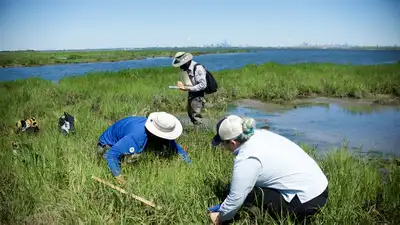
In 2003, a restoration effort at New York City’s Big Egg Marsh took a major step when National Park Service scientists and 100 volunteers planted 20,000 smooth cordgrass seedlings across an area that had been raised with clean sand. Just two years into the restoration, more than 80% of the experiment site was reported to be vegetated and healthy, offering an encouraging result for the damaged marsh. The work was part of an experiment to restore a salt marsh in Jamaica Bay, where marshes had been disappearing for decades. The seedlings faced early setbacks, including grazing by geese, tides and marine debris. The vegetation continued to spread.
In October 2003, National Park Service scientists and 100 volunteers planted 20,000 seedlings of smooth cordgrass, known scientifically as Spartina alterniflora. Monitoring began in 2004 and continued several times a year through 2008. The National Park Service reports that over 80% of its experimental site was vegetated and healthy. In 2021, nearly two decades after restoration began in 2002, Dr George W. The restoration also helped pave the way for other projects in Jamaica Bay, with efforts across the bay eventually restoring more than 150 acres of marshland.
Because it can thrive in high-salinity environments, smooth cordgrass was particularly suited to the difficult conditions of a salt marsh.
The plant’s roots trap sediment, allowing it to build up into nutrient-rich peat, according to the National Park Service. Once the marsh had been raised, the restoration team needed to establish vegetation across the treated area. The planting covered the part of Big Egg Marsh where the sand had been sprayed. That peat creates a stronger foundation for further plant growth, meaning the vegetation could contribute to the longer-term development and stability covering the restored ground. The planting was followed by systematic monitoring. Scientists established one-metre-by-one-metre plots across Big Egg Marsh and repeatedly returned to record elevation, plant numbers, soil characteristics and the animals present. This allowed researchers to track changes over time rather than judging the restoration from a single observation. Geese ate some of the seedlings, while tides washed others away and marine debris such as logs, bottles, plastic bags and straw buried or suffocated some plants. Despite these losses, smooth cordgrass continued to grow, while new seedlings appeared naturally and saltmeadow cordgrass, or salt hay (Spartina patens), also began to establish. Two years into the restoration, the results showed a substantial change across the experiment area. This meant that despite the early losses among planted seedlings, vegetation had successfully become established across most of the restoration site. Monitoring continued to provide information about what happened to the marsh over the longer term. Frame returned to Big Egg Marsh to examine its condition. Catch the latest World News and Live updates. Download the TOI app.