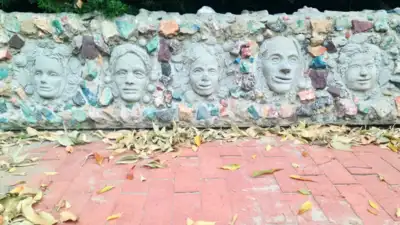
Sculpted faces at Old Trapper’s Lodge | Wikimedia Commons
SPACES Archives documents the project as running from about 1951 to 1981, the year Ehn died. A visit to Knott’s Berry Farm started the project Ehn was born Johan Henry Ehn in Michigan in 1897, and worked as a game warden and later trapped alligators and snakes in Florida. The Los Angeles Times reported in 1986 that Ehn’s artistic work began after a 1951 visit to Knott’s Berry Farm, where he hired sculptor Claude Bell to make a large concrete figure of him as a trapper. Old Trapper’s Lodge was designated a state historical landmark in 1981 (the year Ehn died at age 84) by California. In 1987, Ehn’s heirs agreed to sell the site, which was acquired for expansion that was connected with Burbank Airport. A July 1988 Los Angeles Times report said that the airport authority planned to demolish the buildings and that the family had been searching for a new home for the sculptures, with the Los Angeles Community College District accepting 20 statues as a gift.
Because of spinal inflammation, and moved with his family to Southern California and opened a motel, he was forced to stop trapping in 1940.
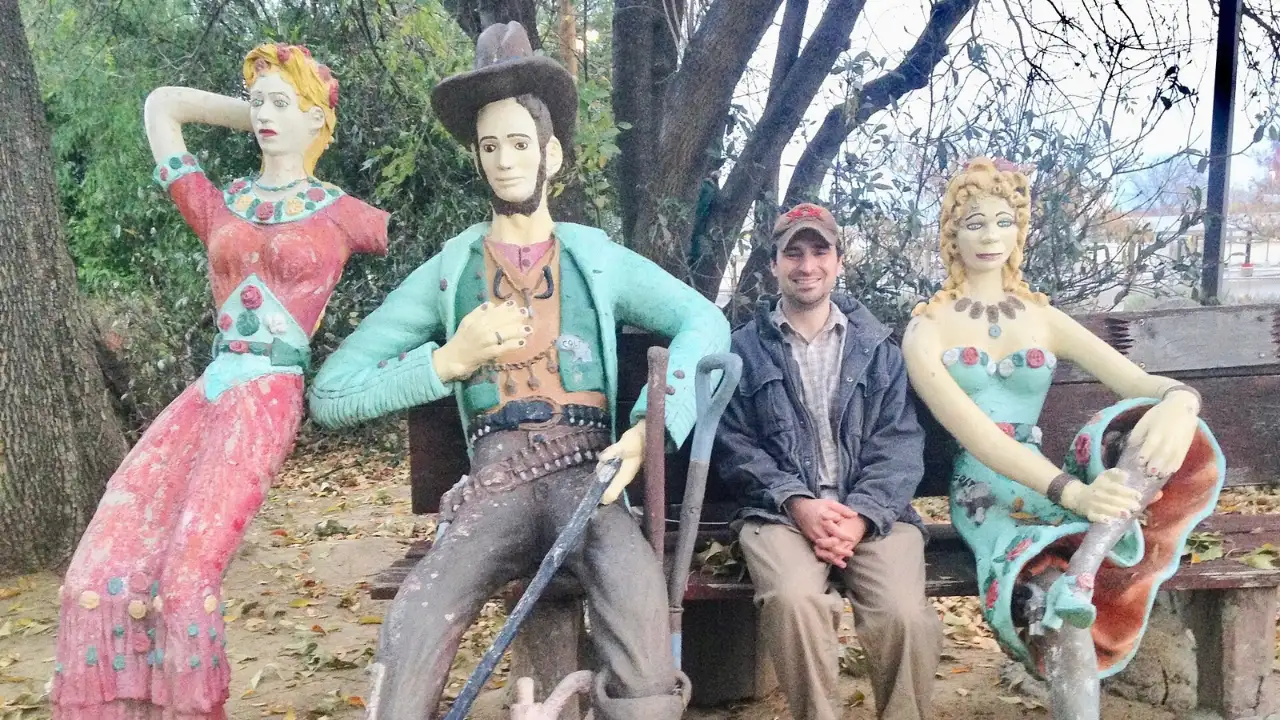
The 1986 Los Angeles Times report described a display labelled “Pontiac Spring” that contained a coil spring taken from a Pontiac automobile, and Ehn’s motto, “Waste Not Want Not,” also appeared in the way he incorporated odds and ends into the environment. Several of Ehn’s larger sculptures were moved to Pierce College in the mid-1980s, where SPACES Archives says they remain available for public viewing, while smaller works are held by the Oakland Museum of California. Old Trapper’s Lodge is a collection of concrete sculptures, homemade tombstones and Old West displays that was built by John Ehn at the California motel that he operated with his family. He was a self-taught artist who used life masks of relatives to shape the faces of figures in his fictional Boot Hill Cemetery. The site grew into a large folk-art environment that included characters that were drawn from songs, folktales and stories of the American West. He named the property Old Trapper’s Lodge, and became known for his Western clothing, goatee and other distinctive accessories. Ehn watched Bell work for three days, then tried the technique himself. Ehn built the sculptures by first assembling a wire framework and covering it with cement, and he often painted the finished figures in bright colours. His first major series became Boot Hill Cemetery, which is a mock graveyard that is filled with Old West characters and tombstones carrying invented accounts of their deaths. The life masks he made of family members supplied the faces for the statues, and their identities were drawn from the songs and stories he enjoyed. The wider property also housed his Old West Mooseum, which displayed trapping equipment, animal skins, photographs, tools and personal memorabilia. Otl ladies – Old Trapper’s Lodge | Wikimedia Commons The motel’s sculptures faced relocation The displays included comic details as well as scenes of violence and frontier folklore, since a tombstone could describe how absurdly a character died, while another exhibit would use an ordinary object as a joke. The motel office became a part of the installation, and objects from his trapping years and family life were arranged among historical photographs and other keepsakes. The original motel and its full collection are gone, but the surviving sculptures stil preserve parts of the project Ehn built over three decades. You use AI every day. Now get your AI Quotient. Take the AIQ test.