
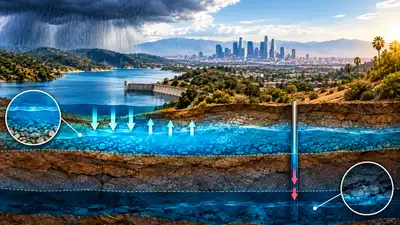
Representative Image (AI-generated)
Record-breaking rainfall in 2023 brought dramatic relief to drought-stricken Southern California, nearly restoring water stored in Los Angeles-area reservoirs and shallow aquifers. A study published in Science found that aquifers deeper than about 50 metres remained substantially depleted. Researchers estimated that only about 25% of the groundwater lost from these deeper aquifers since 2006 was restored after the exceptionally wet year.
Los Angeles was drenched by historic storms, yet much of its lost groundwater stayed missing. But the recovery was far less complete underground.
Near-surface groundwater storage almost completely recovered following the wet 2023 season, while aquifers below roughly 50 metres remained substantially depleted. Only about one-quarter of the groundwater lost from these deeper systems since 2006 had been restored. The researchers concluded that the enormous storms of 2023 were not enough to reverse the groundwater depletion that had accumulated during previous droughts.
Because a wet year can create the impression that a drought has been completely reversed when substantial water losses remain hidden underground, that distinction is important. Changes in groundwater levels can therefore alter the way seismic waves move through the subsurface. As a result, a single exceptionally wet season cannot necessarily compensate for years of groundwater extraction.
Many more wet years would be needed for the deeper aquifers to fully recover, according to the lead study author and researcher Shujuan Mao. Groundwater does not respond to rainfall as quickly or uniformly as reservoirs and shallow aquifers. Water reaching the ground must move through layers of soil and rock before it can replenish deeper groundwater. The study found a clear difference with depth. The researchers tracked groundwater changes across the Greater Los Angeles region over roughly two decades. Their analysis showed that deeper aquifers had experienced a continuing depletion trend, in contrast to shallow groundwater, which fluctuated more closely with changes in weather and precipitation. One of the unusual aspects of the research was how scientists measured changes in groundwater. Alongside conventional groundwater observations, the team used seismic ambient-field interferometry to track changes across the region, analysing seismic waves recorded by the region’s earthquake-monitoring network. Seismic waves travel differently through underground materials depending partly on their physical properties. The contrasting response between shallow and deep aquifers reflects how difficult it is for stormwater to reach deeper underground layers. Heavy rainfall can quickly increase surface-water storage and replenish shallow groundwater. But reaching deeper aquifers requires water to move through substantial thicknesses of soil and rock. In an urbanised region such as Los Angeles, much of the rainfall can also become runoff rather than infiltrating deeply into the ground. The findings highlight an important difference between surface-water recovery and groundwater recovery. Reservoir levels can rise rapidly after major storms, while underground reserves may take much longer to rebuild. This matters for the Greater Los Angeles region, where groundwater is an important water resource for millions of people. The study suggests that assessing drought recovery solely by looking at rainfall, reservoirs or shallow groundwater can give an incomplete picture of the region’s water situation.