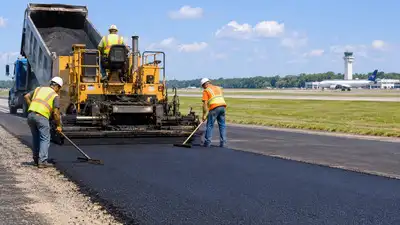
Representative AI image of asphalt paving at an airport, illustrating Minnesota’s early experiment with sewage-sludge ash in road construction. Image Credits: ChatGPT.
Field demonstrations were conducted in 1983 at Minnesota Saint Paul International Airport. These mixtures used either 2% or 3% ash, depending on the test, and the I–94 bridge overpass project used a wearing course in 1989 and 1992. A segment of TH-47 in Ramsay was made with a 2% ash content in the levelling and wearing courses, while TH-97 in Forest Lake Township was constructed with a 2% ash content in its base, binder, and wearing courses.
Therefore, the finely divided nature of the ash made it a suitable replacement for materials like stone dust and hydrated lime. FHWA reported that there was no apparent difference between sections with sewage sludge ash and conventional sections. A unique experiment in constructing roads in Minnesota illustrated how the material that was left over from the sewage treatment process could be recycled as well as used for building purposes. The engineers did not want to discard all of the ash from sewage-sludge incineration, but instead wanted to use it in asphalt road construction. The utilisation of this material would help solve two problems: the growing quantity of waste from the sewage treatment plants and the utilisation of materials in road construction. Incineration of the sewage sludge leads to the formation of ash residue, which needs proper handling. The Metropolitan Base Control Commission of Minnesota, currently operating under the Environmental Services of Metropolitan Council, has initiated a study on the use of this residue in construction rather than disposal. The study was focused on the use of sewage sludge ash as mineral fillers in hot mix asphalt (HMA). Mineral fillers are useful for occupying spaces between aggregate particles in HMA. Initial investigation by the Minnesota Department of Transportation examined the physical properties of the ash and its behaviour in asphalt mixtures. Research published in Construction and Building Materials has also studied the use of sewage sludge ash as a substitute for regular mineral failure in asphalt pavement mixtures, considering aspects like stability, density, and air void content. The Minnesota experiment was especially noteworthy since no special road construction methods had to be developed. The ash could be incorporated into regular asphalt mixers without any need for a new method of mixing, laying, or compacting the material. Two bypass roads utilised sludge ash as a constituent of pavement layers such as base binder and wearing courses. These projects provide possibilities for testing this material in real traffic and weather conditions, unlike a laboratory setting. It is quite promising, but this does not mean that these pavements perform equally well across all settings. However, the organisation indicated that, despite the successes of sewage sludge, it has not yet been accepted for broader commercial use in the USA. Such implementation requires specific material requirements, mix design standards, and environmental monitoring. Nevertheless, an experiment conducted by the state of Minnesota provided an available example of recycling waste in transport infrastructure.