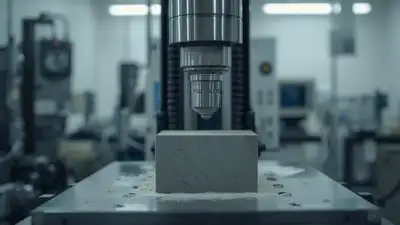
Representative image of testing machine pressing down hard on a solid rectangular block made of a grey sand-composite structural material. (Image Credits: Perplexity.ai)
Researchers in 2020 developed a structural material through the combination of sand with only about 10 wt% polyethylene and compacting the mixture under pressure. The polyethylene particles used were around 40-50 micrometers in size and sand which met the required ASTM C33/33M. The binder content was varied from 4 wt% to 30 wt%, while compaction pressure ranged from 70 MPa to 350 MPa. How the sand-polyethylene material was made The sand and polyethylene (PE) particles were manually mixed before being placed in a steel mold heated at about 200°C, it was then subjected to compaction pressures ranging from 70 to 350 MPa. Researchers observed that, at 4 wt% polyethylene, the material would reach about 8 MPa, giving it nearly twice the strength of typical concrete. Going up to 7 wt% increased the flexural strength to around 14 MPa, comparable to any steel-reinforced concrete and at 10 wt%, it rose sharply to 23 MPa. Beyond the 10 wt% threshold, further additions of polyethylene yielded smaller gains in structural reinforcement. Though the material achieved its highest strength of 30 MPa, at 25 wt% PE. Raising the pressure from 70 MPa to 140 MPa increased strength from around 22 MPa to 27 MPa, marking an improvement of nearly 22% but when it went above 140 MPa, then it didn’t produce any additional strengthening. The study identified that the preferred range for production was a 7–10 wt% polyethylene and compaction pressure of 70–100 MPa. Before compaction, the samples were heated at 200°C and by increasing the heating duration from 10 to 30 minutes enhanced the material’s strength from 14 MPa to 25 MPa, giving a 79% increase. An interval of less than one minute yielded the highest strength and three to six minutes would level the strength at only 40-60% of the peak value, while an interval of ten minutes would reduce the strength by 80%. The study also found that if the materials were confined when heated, the material’s strength would reduce by 25% which meant that free expansion during heating allowed polyethylene to spread through the sand structure.
Because of oxidation and possibly the polyethylene’s thermal decomposition, which can reduce the effective molecular weight of the polymer, in contrast, longer heating at 50-60 minutes would reduce the strength to around 14 MPa, as observed by researchers this decline was.
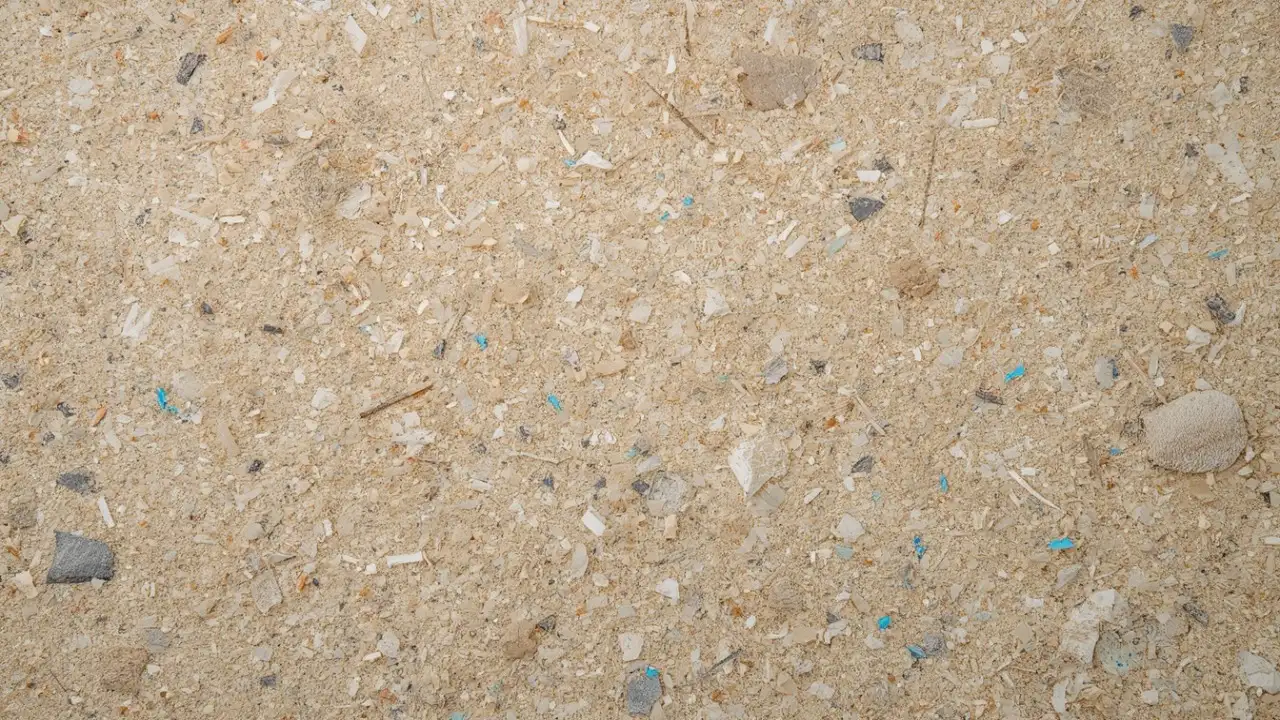
The study published as “Sand-Filler Structural Material with Low Content of Polyethylene Binder ,” showed by using about 10 wt% polyethylene and 70–100 MPa of compaction pressure, the formulation produced flexural strength greater than typical steel-reinforced concrete. In lieu of using Portland cement, polyethylene, a common plastic, was used to bind sand particles together. The idea behind this approach was to reduce the amount of polymer normally required in constructing plastic based materials and to determine if it was possible to create a different route for recycling waste plastics. To distribute the binder, researchers weren’t reliant on extensive mechanical mixing which made the process different from when using conventional polymer cement. Under pressure, the sand grains started to shift, rotate, deform slightly, and drove the melted polyethylene towards the contact points between neighboring grains. Following this arrangement allowed a small amount to contribute largely to the strength of the material. Representative image of concrete material made from compressed sand and plastic. (Image Credits: Chatgpt) The materials’ performance was determined by heating and processing The final materials properties were significantly influenced by both temperature and processing duration. The time between removing the heated mould from the oven and beginning compaction was also important. This approach speaks to the issue of Portland cement production being carbon-intensive, and waste plastics are difficult to recycle. Since building materials are tolerant to minor impurities, the researchers proposed that waste plastic could potentially be used as a binder. You use AI every day. Now get your AI Quotient. Take the AIQ test.