
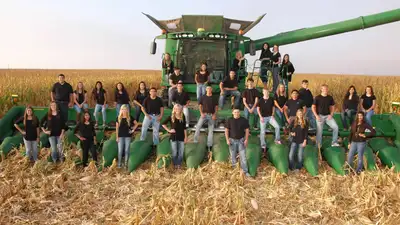
What began with a 640-acre donation to the Gruver Independent School District in 1984 has evolved into a community-run farming initiative that generates hundreds of thousands of dollars every year for student scholarships. A November 2 report by The Washington Post, along with information from Gruver High School and West Texas A&M University, highlights how local farmers have turned their time, equipment and harvests into an investment in the next generation. But around 15 years ago, school officials began considering whether the land could serve a much bigger purpose.
In a small farming community in the Texas Panhandle, a piece of inherited farmland has become an unexpected way to help young people afford higher education. The land was donated by longtime Gruver resident Karl Nielsen, who left the property to the school district. For years, the district leased it to farmers, using the rental income to support educational needs, including the purchase of textbooks and laboratory equipment. During a conversation with local farmers at a high school football game, the idea emerged to use the property to fund college education directly.
The initiative took shape around 2012, with farmers volunteering to grow corn and wheat on the district-owned property. The first students to benefit were members of the Class of 2016. Since then, the programme has distributed nearly $3 million in scholarships to approximately 300 students, according to the school district. Annual harvests generate around $400,000 for the scholarship fund, although the amount can vary depending on agricultural conditions and crop yields. Individual students can receive as much as $40,000 towards their education. 48 scholarship recipients have become the first members of their families to graduate from college, according to the latest figures reported by The Washington Post. The support has made a difference for students such as Sydney Ortiz, who graduated from Gruver High School in 2023. Through her academic performance, extracurricular participation and volunteer work, she earned approximately $3,000 per semester in scholarship assistance. Another beneficiary, Rhett Sparks, graduated from Gruver High in 2020 and completed an agriculture degree at West Texas A&M in 2023.
Instead of leasing the fields, farmers would cultivate them without charging for their labour or equipment. The crops would then be sold, with the proceeds going towards scholarships for Gruver High School students. It was an unusual arrangement that depended heavily on the willingness of an entire community to contribute. The scholarship is not distributed equally among all graduates. Students build up points throughout high school based on their academic performance, test scores, participation in extracurricular activities and community service. Their accumulated points help determine how much financial assistance they receive. One of the programme’s most significant outcomes has been the opportunities it has created for students whose families have never had a college graduate. Her parents immigrated to the United States from Chihuahua, Mexico, and she had worried about how she would afford university. She is now studying education at West Texas A&M University. The scholarship helped him avoid much of the student debt he might otherwise have accumulated. He has since returned to Gruver to work as a farmer and pesticide applicator, and plans to contribute to the farming initiative himself.
Other former recipients have also returned to the area, working in professions including teaching, nursing, agriculture, mechanics and accounting. The programme has also given younger children an opportunity to understand where their future educational support comes from. Elementary school students visit the farmland during school trips, where they learn about the crops and the history of Karl Nielsen’s donation.