
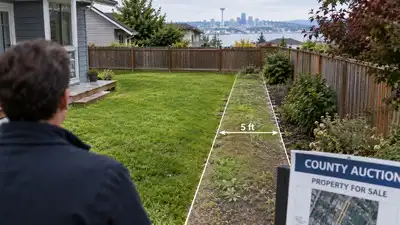
Representative image of a narrow property strip running through a residential backyard after a county auction. Image Credits: ChatGPT.
The strip stretched for about 300 feet and had no direct street access, making it hard to see how it could be used. Harris subsequently listed the narrow Auburn parcel for $3,950. He had acquired at least 30 such parcels in King County since 2018 by paying only the back taxes on them, according to reports.
Because it was only five feet wide and had no street access, it offered little obvious opportunity for construction. These unusual parcels can therefore survive on official maps even when their practical purpose has become difficult to identify.
Ward and his neighbour, Joe Hoeft, had long known that the unusual piece of land appeared on county maps, according to Tribune News Service. Such “dangling strips” can be created because of errors in legal descriptions or surveys, subdivision mistakes, or mismeasurement by the county assessor’s office, according to King County . Many of them are described by the county as “dangling strips” or “isolated triangles,” as they are usually considered worthless since they did not fetch any bids during the previous auction.
Imagine discovering that a narrow strip of land running through your backyard belongs to a stranger. That was the surprise facing Harlen Ward, a homeowner in Auburn, Washington, after a stranger bought a five-foot-wide parcel of land between his property and a neighbour’s at a King County auction. What they did not expect was for someone to purchase it. The parcel was eventually bought by Ben Harris, a California entrepreneur who specialises in buying unusual properties at county auctions and reselling them. How a strip of land ended up between homes The five-foot-wide parcel was one of several unusual properties appearing in the Seattle region’s county property system. Some are only a few inches wide, while others extend considerable distances. In Ward’s case, the parcel ran between his property and Hoeft’s, surrounded by residential homes. Research into urban vacant land has found that government parcel records can contain outdated information, transcription errors and incomplete details about a property’s status or use. A study published in Landscape and Urban Planning also noted that vacant parcels can fall into categories including unusually shaped land and plots too small to be developed. Image Credits: Wikimedia Commons. The business behind unwanted land King County’s process helps explain how land that neighbours saw as worthless could still attract a buyer. A piece of land can enter King County’s tax foreclosure program after property taxes go unpaid for some time. Properties that do not sell at the annual tax foreclosure sale may become what the county calls tax title properties. Harris’s strategy involved acquiring such odd parcels of land. He would market some of these parcels to neighbouring homeowners or others who could find some practical use for them.

Why these tiny parcels still matter King County also says its property information is mainly used to calculate taxes and does not guarantee that land can be developed. His strategy was not limited to Auburn. The other plots of land that he bought included a tiny plot of driveway in the area of Seward Park in Seattle, and a small triangle of land bounded on all sides by properties in Mercer Island. These parcels could sell for several thousand dollars even though they offered little or no development potential. However, for a neighbour, there may be another advantage of purchasing a particular plot of land. Owning a strip of land could prevent an unknown person from controlling the land next to a homeowner’s property. They sell properties that are foreclosed for tax purposes, “as is. It encourages the buyer to do independent investigation. This is especially true when it comes to narrow pieces of land, like the piece passing through Ward’s yard. Ward’s experience showed how a seemingly insignificant strip of land could have its own legal identity and be purchased by someone else. What appeared to be an ordinary part of his backyard was separately recorded as a parcel in the county’s property records. Auburn’s example shows how complicated property ownership can become even on a very small scale. A strip of land just five feet wide might be unsuitable for building and difficult to access, but it could still be legally owned by someone else if it was recorded as a separate parcel running through a homeowner’s property. You use AI every day. Now get your AI Quotient. Take the AIQ test.