
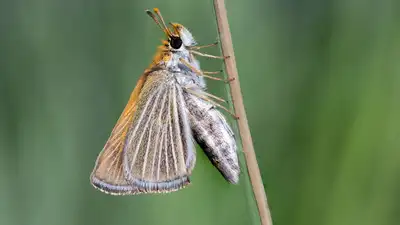
Poweshiek skipperling, PC: David Pavlik
The programme released 102 Poweshiek skipperlings in 2022 and more than 1,300 in 2025. Less than 1% of the prairie habitat that once existed remains today, according to MSU. Because several populations survived in the state’s remaining prairie fen habitats, michigan has become a critical stronghold for the Poweshiek skipperling.
Researchers raised butterflies in captivity and released them at suitable recovery sites, gradually shifting the focus from simply preventing extinction toward rebuilding populations in the wild.
David Pavlik, a research assistant at MSU’s W.K, according to Michigan State University. Kellogg Biological Station and John Ball Zoo, has helped lead the recovery effort. The initial goal was to keep the species from disappearing entirely from the United States. The effort brings together MSU researchers and conservation organisations including John Ball Zoo, Minnesota Zoo, the U.S. Fish and Wildlife Service and the Michigan Department of Natural Resources. The butterfly has disappeared from most of its former U.S. range and now survives at only a small number of locations in southeast Michigan, along with a remaining population in Manitoba, Canada. Bill Flanagan, conservation manager at John Ball Zoo, has described Michigan as an important stronghold for the species and a key location for conservation work. The decline of the Poweshiek skipperling is closely associated with the loss of the habitat it depends on. Habitat loss, wetland destruction, changes in agricultural practices and pesticide exposure have all contributed to the pressures facing the species and the wider prairie ecosystem.
By 2022, surveys found only 9 Poweshiek skipperlings in the entire United States. The team released 102 butterflies in 2022 and more than 1,300 in 2025. By 2026, researchers were reporting hundreds at recovery sites in southeast Michigan, providing a striking sign of progress for a species that only a few years earlier had just 9 known wild individuals in the United States.
The Poweshiek skipperling, a small prairie butterfly once widespread across the American Midwest and parts of Canada, came dangerously close to disappearing from the United States. After populations began collapsing in the early 2000s, the species was reduced to just a handful of known wild individuals. At one point during the recovery effort, conservationists were caring for more individuals in captivity than remained in the wild anywhere in the world. Researchers at Michigan State University, working with John Ball Zoo, Minnesota Zoo, the U.S. Fish and Wildlife Service and the Michigan Department of Natural Resources, developed a captive-rearing and release programme aimed at preventing the species from disappearing.