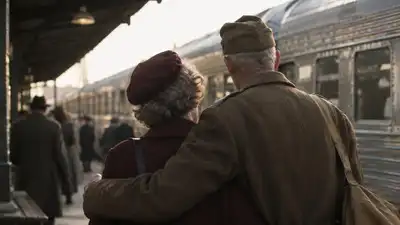
A representative AI image of an elderly couple stands arm in arm on a vintage train platform. (Image Credits: ChatGPT)
A train journey across the United States in June 1944, the National WWII Museum records, brought the couple together. They married in September 1944 and spent their honeymoon in San Francisco, according to the National WWII Museum. Per the museum’s account, the letters began in December 1944. Richard kept the cards and correspondence; the museum holds hundreds of their exchanges from December 1944 until November 1945. Their first child was born in August 1945, while Richard was still in the Pacific and serving as a lieutenant junior grade. They remained married for 64 years.
The men flipped a coin to decide who would approach her, and as fate would have it, Richard won the toss, according to the National WWII Museum .
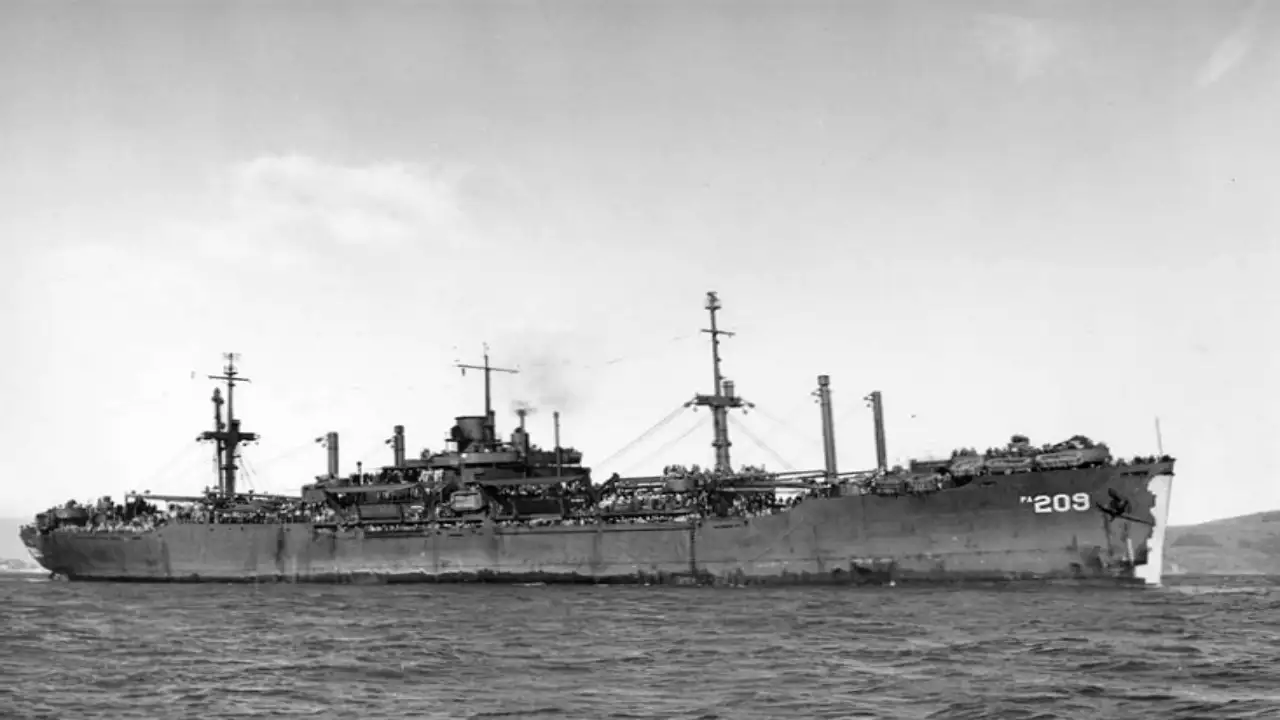
In a letter sent shortly before Christmas, Jean had told him that she suspected she was pregnant. real-life encounters prove love remains unpredictable in its ways While romantic clichés would suggest feelings don’t ask for an invitation. A lifetime together can be traced back to a brushed shoulder on a crowded street or a forgotten handkerchief on a bus seat. For Richard Porritt Sr. and Jean Wadsten, it started abroad, on a train, with a passing glance and little encouragement from friends. What followed outlasted the wartime separation that tested their marriage, preserved in the hundreds of letters exchanged across the Pacific. Richard, a Navy ensign with orders to report to the USS Tazewell, noticed Jean during a stop in Chicago. She was travelling west with her sister and four-year-old niece. He assumed she was married. By the next terminal, his friends persuaded him to dig further. He learnt that Jean was unmarried and that the little girl was her niece, Janet. He and his friends began visiting Jean’s compartment. She enjoyed their company, though Richard became the one she wanted to talk to. Jean grew up in a strict Lutheran upbringing, while Richard, whose parents were divorced, was described as impulsive and less restrained in his speech and behaviour. The differences did not stop either of them from falling in love. When they were able to meet, Richard arranged dates around San Francisco. They ate out, danced and walked in the city’s parks. Soon after, he proposed in a cinema, and she accepted. However, their time together was rather brief. The USS Tazewell was commissioned and sent from San Francisco to Seattle to take on personnel and supplies. It then sailed for Hawaii, where it embarked garrison troops for the Palau Islands before steaming onward. Richard’s assignment meant that the newlyweds would be separated for a period. Richard asked Jean to write often: “You see, darling, mail is a fellow’s whole life out here and it’s the greatest morale builder there is. Richard’s words echoed the sentiment of men serving at sea, for whom letters were the only link to the world they had left behind. Image of the USS Tazewell. (Image Credits: Wikimedia Commons) Letters of love, family and future Jean sent cards and letters, often using Valentine’s Day as an occasion for a personal message. Her first Valentine that year arrived in January in the form of an illustrated fold-out card. It contained a self-deprecating poem and a short message in her teal ink, “Love, guess who! An arrow directed Richard to turn the card over for the answer. She wrote about missing him, longing for his return and waiting to feel the baby move. The news delighted Richard even as he regretted being away. Jean also kept him informed about family matters and events at home. Richard, on the other hand, wrote what he could disclose of his service, his efforts to stop gambling, and his intention to read the Bible. He even promised to curb his habit of swearing. In the weeks that followed, Jean sent more cards. One contained a portrait of herself for Richard to keep beside his bed. She left a lipstick kiss on the final page and sprayed the stationery with the perfume she had worn at their wedding and honeymoon. A month after the holiday, she used an unused Valentine card as a general, crossing out words that no longer fit. Their letters also record the future they tried to imagine. For Richard, it was a toss-up between the Navy, teaching or settling near relatives on the North Atlantic coast or in California. He did not want a life that would warrant further separations. For Jean, it was less about the location and more about being together. Both wanted a large family. Eventually, the couple had five children; one died in infancy. Later, their children donated their letters to the National WWII Museum. You use AI every day. Now get your AI Quotient. Take the AIQ test.
Before the summer was over, he had decided he wanted to marry Jean. In another letter, written two days before Valentine’s Day, she recalled their time together before the Navy took him away.