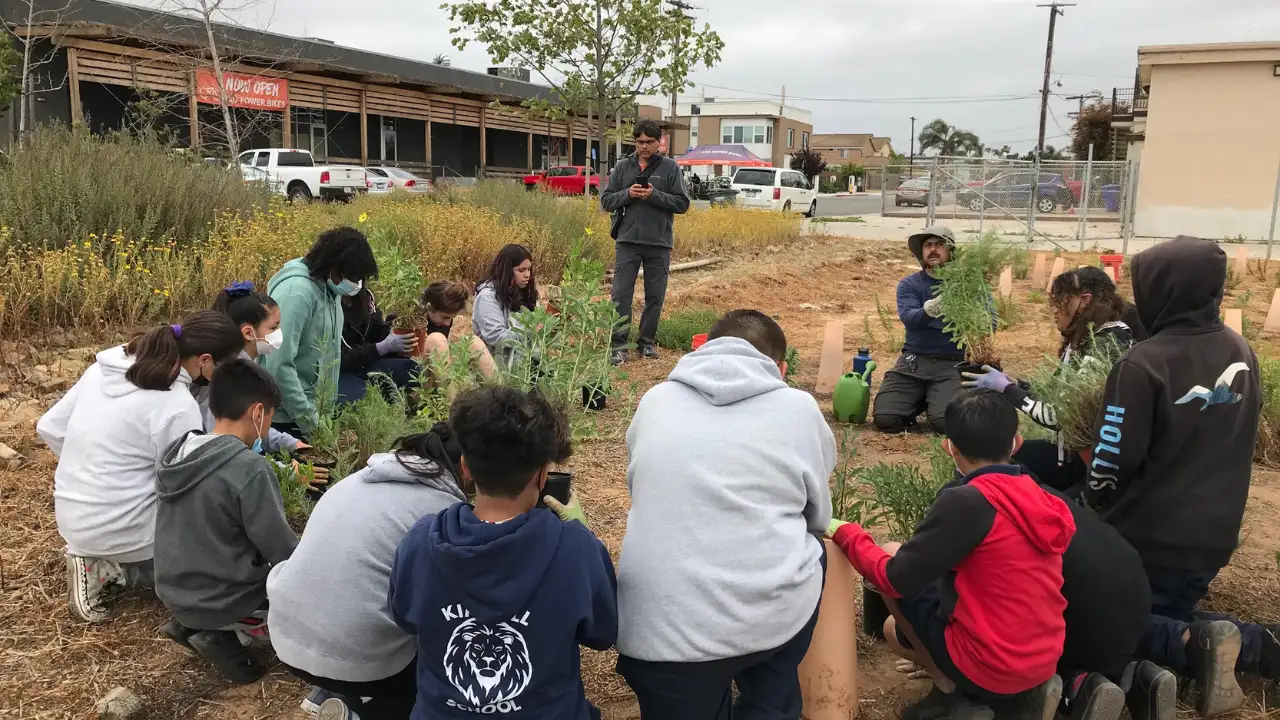
Nearly 350 San Diego high-school students have spent the past four years turning school grounds and community spaces into native wildlife gardens, helping create or restore almost 25,000 square feet of habitat through 39 gardens. The work is part of the Native Biodiversity Corps, a San Diego Zoo Wildlife Alliance programme launched in 2022 to give students hands-on experience in conservation. Participants learn about native plants, wildlife and habitat restoration before designing, planting and maintaining gardens with guidance from conservation professionals. The gardens are intended to provide resources for pollinators and other local wildlife in urban areas while giving students practical conservation skills. The programme has also expanded beyond schools, with students helping transform an unused golf-course space into a native garden.
The Native Biodiversity Corps began in spring 2022 with funding from San Diego’s Level Up programme. More than 300 urban high-school students registered within 72 hours, while about 100 students were selected for the inaugural programme. Nearly 350 students have participated in the Native Biodiversity Corps since its launch, according to San Diego Zoo Wildlife Alliance’s September 2026 update. Together, they have helped create or restore almost 25,000 square feet of habitat through 39 gardens on school grounds and elsewhere across San Diego County. In one project, Native Biodiversity Corps participants worked with Pro Kids, First Tee to transform an unused chipping range at Colina Park Golf Course into a waterwise native garden containing 27 different native plant species. During the 2026 summer programme, students also worked with the San Diego Zoo Safari Park’s horticulture team to design and install a native wildlife garden at the Beckman Center for Conservation Research.
Participants spent the summer visiting conservation sites including the San Diego Zoo, San Diego Zoo Safari Park, San Diego Natural History Museum, Living Coast Discovery Center and San Elijo Lagoon Ecological Reserve. A central aim of the gardens is to provide food and habitat for pollinators and other wildlife. At Hoover High School, students transformed a tree planter into a pollinator garden containing California poppy, narrowleaf milkweed, showy penstemon and California buckwheat. At Crawford High School, students transformed an undeveloped hillside into a green space. The students’ conservation work has increasingly moved into wider community spaces. These projects have allowed students to take the skills learned at school and apply them to larger community and conservation settings.
Some of the projects have involved spaces that previously provided little habitat. At another location, students created a native garden on a previously bare hillside, with the goal of providing habitat resources for local pollinators.