
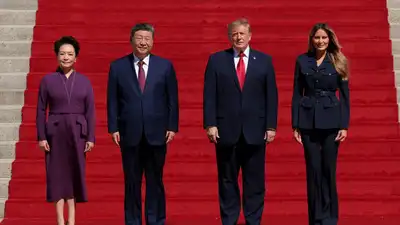
US President Donald Trump, first lady Melania Trump, Chinese President Xi Jinping and his wife Peng Liyuan pose at the entrance of the National Archives Museum in Washington. (Reuters image)
Trump said the talks had produced “tremendous strides” and suggested US farmers would benefit from agreements reached with Beijing, but offered few details. “I think our farmers are going to be happy,” Trump said during tea at the White House. “America is very happy about this visit, and I’m sure China is very happy also,” he said.
US President Donald Trump and Chinese President Xi Jinping wrapped up their three-day summit on Friday with tea at the White House and a tour of the National Archives, ending a high-profile visit marked by personal diplomacy and ceremony but few major public breakthroughs on trade, Taiwan, artificial intelligence or other contentious issues.
Critics question lack of concrete breakthroughs
After his May summit with Xi, Trump said he was holding a second Taiwan arms package worth about $14 billion in abeyance, describing it as a “very good negotiating chip. His administration had previously approved an $11 billion arms sale package for Taiwan. “Ours goes 250 years, which is great, and we’re proud of it. But theirs goes 6,000 years. He added: “There’s a little difference between 6,000 and 250, but we’re very proud of our 250.
The summit therefore ended with both leaders publicly emphasising stability and continued engagement, while several of the most difficult issues between the world’s two largest economies remain subject to further negotiations. China’s state news agency also reported that Xi “hopes the US side will adhere to the correct position of opposing ‘Taiwan independence’. Trump confirmed that the two leaders also discussed the war involving Iran.
Trump pointed to progress under a bilateral trade mechanism and said US farmers and ranchers would benefit from increased access to the Chinese market. Greer said the US and China had agreed to exempt some key goods from their trade disputes, including US agricultural products and medical devices, as well as Chinese imports of consumer and non-sensitive goods. Trump said the visit also reflected the long history of the two countries. “Just as our ancestors reached across the ocean centuries ago to trade, to learn, and to build a better world, our two countries do really the same thing, and we’re very proud of it and the relationship,” Trump said. “We’re just comparing,” Trump said. “We did, we did,” Trump said when asked at the National Archives whether Iran had been discussed. Senate Democrats said Trump had failed to secure meaningful concessions on trade, security, artificial intelligence and human rights. Analyst Craig Singleton of the Foundation for Defense of Democracies said Beijing may view the current restraint on Taiwan arms sales as a new baseline in its relationship with Washington. He said Xi’s use of the word “adhere” was revealing because “it implies Beijing believes Washington is already behaving in ways it wants. “In the context of the current standdown on Taiwan arms sales, China may increasingly view that restraint as a new baseline rather than a temporary pause,” he said.
Trump responded: “We will, and we’ll be speaking a lot. Trade remained one of the central issues in the summit, but the two sides did not announce a major new agreement during the visit. “We’re in a managed trade situation. … The agreements come as the two countries continue to manage tensions over tariffs, market access and other trade restrictions. Taiwan remained one of the most sensitive issues surrounding the summit. China claims democratically governed Taiwan as part of its territory and has long sought stronger US recognition of Beijing’s position on the island. The United States does not have formal diplomatic relations with Taiwan, but Washington is the island’s most important international backer and US law requires it to provide Taiwan with the means to defend itself. Trump’s comments following the summit will be closely watched by US allies in Asia for indications of how Washington intends to approach Taiwan after Xi’s visit. Trump and Xi ended the visit at the National Archives in Washington, where they viewed the Declaration of Independence, the US Constitution and the Bill of Rights. The visit came as the United States prepares to mark the 250th anniversary of the signing of the Declaration of Independence. During the visit, Trump and Xi also discussed the age and history of their respective countries. The National Archives tour also carried symbolic weight as the leaders sought to present the relationship between the two countries as stable despite continuing strategic differences. Despite the extensive ceremony surrounding Xi’s visit, critics in the United States questioned whether the summit produced sufficient concessions from Beijing. “Beijing’s objective is to get Trump to absorb Chinese red lines into his own definition of a stable relationship. You use AI every day. Now get your AI Quotient. Take the AIQ test.
They also criticised Trump for not publicly addressing China’s military pressure on Taiwan and called for the immediate delivery of previously approved military aid and arms sales to the island. US Trade Representative Jamieson Greer said details of the limited agreements reached between Washington and Beijing would be released on Monday. We’ve had progress, and we will release on Monday, I think, a lot more details about what we’ve accomplished over the past few weeks in negotiating with the Chinese,” he said. Xi pressed Trump on the issue during their talks on Thursday, saying he hoped the United States would “handle the Taiwan question with prudence.
Xi described the US-China relationship as one of “strategic stability on the basis of respect, fairness and reciprocity” and said he expected to meet Trump twice more this year. The Chinese president invited Trump and first lady Melania Trump to visit China for the Asia-Pacific Economic Cooperation summit in Shenzhen in November and said the two leaders could meet again at the G20 summit in Miami in December. President and the First Lady to visit China,” Xi said. Asked whether he expected progress on reopening the Strait of Hormuz, a key route for global oil shipments, Trump said: “I think we’re going to do great. Xi calls relationship one of ‘strategic stability’ Xi said his Washington visit had added “new substance” to the relationship between the two countries. He said the two sides had agreed to develop a constructive relationship based on “strategic stability on the basis of respect, fairness and reciprocity. The Chinese president also said the leaders would have two more opportunities to meet before the end of the year, potentially increasing the frequency of direct engagement between Washington and Beijing.
“I do welcome you, Mr. Trump did not elaborate on what was discussed or whether the two sides had reached any understanding on the issue. Beijing has denied US allegations that it has supported Iran in the conflict. Artificial intelligence was another area where Washington and Beijing identified potential cooperation, although the summit produced no major public agreement on the issue. The two governments continue to face broader tensions over advanced technology, access to sensitive technologies and the development of AI capabilities. The absence of a major announcement on AI leaves the issue as one of several areas where the two countries will need further negotiations. Xi’s comments came during his third face-to-face meeting with Trump since the US president returned to power. The meetings could provide opportunities to address issues left unresolved during the Washington summit.