
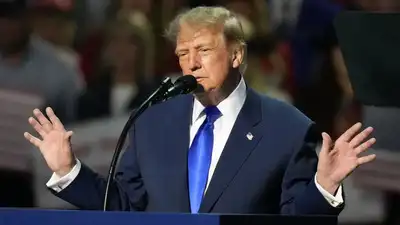
Iran seeks to raise the political and economic cost of war for Trump ahead of US midterms
More than six months after the conflict began on February 28 with US-Israeli attacks that killed Iran’s supreme leader Ali Khamenei, Tehran is taking a more confrontational approach instead of moving towards diplomacy. The Revolutionary Guards said Wednesday that they had targeted 10 vessels attempting to cross the restricted area.. CBS News reported that around eight US F-15 aircraft sustained light damage in Iranian strikes overnight Tuesday. Revolutionary Guards spokesman Hossein Mohebi has also laid out demands for ending the war, including the withdrawal of Israeli forces from south Lebanon and the release of around $24 billion in frozen Iranian assets. The Wall Street Journal reported that US advisers have warned him that Tehran could continue resisting Washington even beyond the end of his presidency in January 2029.
A new prohibited zone in the Strait of Hormuz was announced Sunday by Mohsen Rezaei, the new head of Iran’s Supreme National Security Council and a veteran hardliner.
Trump, who has been pushing for an end to the war as the November 3 midterms approach, said on Wednesday: “I think the war will end immediately after the election” because Iran “can’t hold out any longer”. Sanam Vakil, director of the Middle East and North Africa programme at Chatham House, said Iran “is trying to convert escalation into increased leverage”. “Tehran believes that pressure on Hormuz and the threat of wider disruption can exploit US vulnerabilities, especially the political and economic costs of another Middle East crisis ahead of the midterms,” AFP quoted her as saying. The Revolutionary Guards said they struck a US military base in Jordan after US forces destroyed five Iranian oil tankers a day earlier. They need to deliver,” Rezaei said. “Iran cannot defeat the United States militarily,” said Ali Alfoneh, a senior fellow at the Arab Gulf States Institute, AFP reported. “Instead, Tehran hopes to weaken President Trump politically by contributing to a Republican defeat in the midterm elections — keeping gasoline prices high and reminding American voters that the president has entangled the United States in the very ‘never-ending war’ he promised to avoid,” he added.
Iran, however, has expanded a prohibited zone in the Strait of Hormuz, a key global energy route that normally carries around a fifth of the world’s oil and liquefied natural gas. Analysts say Tehran sees the approaching US elections as an opportunity to increase pressure on Trump without necessarily seeking a decisive military victory. Iran has also continued military action. Iran’s new leadership has continued to take a hard line towards Washington. The country’s supreme leader and his successor, Mojtaba Khamenei, have remained largely out of public view, leaving questions over the chain of command in Tehran. “We don’t trust the United States, and we will not take further steps unless they engage in trust building measures… Iran cannot realistically defeat the US militarily, but analysts say it could seek to make the conflict politically costly for Trump. A prolonged conflict and disruption around Hormuz could put additional pressure on energy prices, potentially increasing the domestic political costs for the Trump administration as voters head to the polls. Trump has nevertheless maintained that Iran is running out of options. Catch the latest World News and Live updates. Download the TOI app.
Iran is stepping up pressure on the United States less than two months before the US midterm elections, with analysts saying Tehran hopes to increase the political and economic costs of the war for President Donald Trump and weaken his position at home.