
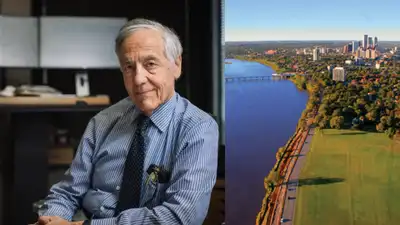
PC: Forbes/Public Radio Tulsa
Associated Press (AP) reported when it opened, the 66-acre first phase brought playgrounds, trails, sports facilities, lawns and gathering areas to the riverfront. The project was backed by the foundation of billionaire philanthropist George Kaiser, whose contribution helped finance a development that would eventually expand towards 100 acres. The first phase covered about 66 acres, with plans for the park to eventually reach roughly 100 acres.
Because the park had been financed privately, the emphasis on accessibility and broad public use was particularly important. As reported by AP News, Gathering Place was conceived as a way of changing that. The Arkansas River was once a difficult backdrop for Tulsa, with stretches of its waterfront offering little reason for residents to linger. That changed with the arrival of Gathering Place, a vast public park built with private funding and designed around recreation, culture and open space. What began as an ambitious piece of urban redevelopment has since become one of Tulsa’s most visited public spaces. Tulsa’s relationship with the Arkansas River has not always been straightforward. The waterway runs through the city, but parts of its banks had long been underused, leaving a large amount of valuable urban space disconnected from everyday life. Rather than treating the riverfront simply as somewhere to pass through, the project put public activity at the centre of the design. The grounds were laid out for different kinds of use, from quiet walks and cycling to organised sport, concerts and family outings. The park was intended to work as a place people could visit for a few hours, but also as a setting for larger civic and cultural events. Gathering Place was built with private money, with major support coming from the George Kaiser Family Foundation. Kaiser, a Tulsa-born billionaire, had already become one of the city’s most prominent philanthropists. His foundation’s involvement gave the riverfront project access to a level of private funding rarely available for a conventional municipal park. The result was not simply a landscaped strip beside the river. The money went towards a substantial collection of facilities and public spaces, creating an environment intended to serve residents across different age groups and interests. Visitors arriving at Gathering Place encounter a park built around movement and activity rather than a single central attraction. There are walking and cycling routes, athletic courts and broad lawns that can accommodate concerts and other gatherings. Play areas were also a major part of the design, with children given dedicated spaces to climb, explore and play. The range of facilities means the park can feel different depending on when it is visited. A weekday morning might bring walkers and families, while evenings and weekends can draw larger crowds for performances and events. The river itself remains an important part of the setting. Instead of turning its back on Arkansas, the park incorporates the waterfront into the experience, making the landscape part of the attraction. When Gathering Place opened, hundreds of people gathered along the Tulsa riverfront to mark the occasion. The launch was designed as a public celebration rather than a conventional ribbon-cutting ceremony. A parade opened the day’s programme, followed by live music and activities for children. Kaiser joined Oklahoma Gov. Mary Fallin and local officials for the opening, as residents explored a park that had taken years of planning and construction to reach that point. The crowds offered an early indication of how much interest the project had generated. For Tulsa, the opening also represented a significant change in how one of the city’s major pieces of open land could be used. City leaders described Gathering Place as more than a collection of playgrounds, sports courts and green spaces. The project was also presented as an experiment in creating a public setting where people from different parts of the city could meet. That ambition influenced the range of spaces included in the park. There are areas intended for active recreation, quieter corners, performance spaces and facilities aimed at families. Its purpose was not to create an exclusive development around the river, but a public destination available to people without an admission charge. You use AI every day. Now get your AI Quotient. Take the AIQ test.