
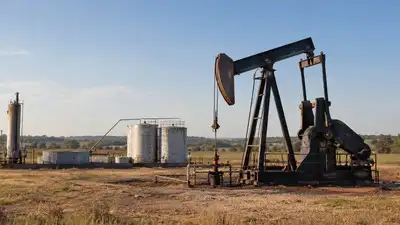
A representative AI image of a traditional oil pumpjack in the development of oil production. (Image Credits: ChatGPT)
In 1957, Milton G. Turner had paid $2,500 for the well, along with its equipment, and 80 surrounding acres in Kentucky’s Green County, according to Time. One such landowner identified by the report was Ellis Hood, a 45-year-old farmer who worked 85 acres of hilly land and earned $325 a day from the oil activity. Another was a former Marine named Early Vaughn Dulworth, who had paid $200 for a partial interest in the Beams lease and received $2,000 a month. In addition, there was a hamburger-stand operator who was collecting $1,500 a month in royalties on the parking lot after he had leased the stand itself for $15 a month. Agreements that had commanded just $1 per farm and one-eighth of the oil the previous spring rose to $2,500 to $3,000 per acre, with farmers receiving a quarter of the oil.
Because of the water mixed with the oil, farmers were aware of oil in a salt-water well dating to 1828, but geologists and oilmen had considered commercial production unfeasible. TIME reported that Turner had offered leases without charges, as that encouraged others to do the same. Turner purchased an oil well abandoned by Starr Gas Co. upon discovering oil mixed with substantial quantities of salt water. His approach to pumping the well would go on to usher in the starting point of a wider oil boom. Turner believed that if the water level was lowered quickly enough, it would allow oil to flow from the rock into the bore. By using tractor power to operate a pump, the well in one day produced as much oil as it had produced in a month under Starr’s pumping arrangement. The discovery took place in a region where oil had long been known but had not been developed on a comparable scale. The leases and wells spread across Green County The subsequent lease arrangements that Turner established served to extend a drilling operation beyond his own footprint. Two additional wells came into production during the winter preceding the report, followed in April by a flowing well on the Frank Beams farm along the main Louisville road, when the boom began. The financial benefits of this phenomenon trickled down to landowners whose farms had initially yielded modest returns. These instances were ample enough to prove that oil rights and land interests could generate income beyond the direct operation of wells. The same effect was apparent in the lease market, which changed sharply. Representative image of an oil pump jack. (Image Credits: Pexels) Production records and transport infrastructure
In his review of the 1958 industry, petroleum geologist Edmund Nosow recorded more than 600 wells completed in Green County, which contributed to a statewide drilling total that exceeded 2,300. A report just a year later in 1959 showed that Kentucky’s oil production had struck a new record at 27,271,956 barrels, an increase of nearly 52%, while Green and Taylor counties accounted for one-third of the state total. TIME reported in December 1958 that Ashland Oil & Refining Co., which purchased much of the field’s output, had invested $200,000 in gathering lines. It was also seeking bids for a $2 million pipeline to its refinery in Louisville, which was approximately 70 miles away. The Kentucky Geological Survey’s historical timeline records that Ashland completed a pipeline from Louisville to the field in 1959 at a cost of approximately $2 million.
Kentucky’s oil production had totalled 17,956,170 barrels that year, according to his article titled “Oil and Gas Developments in Kentucky in 1958”. at its backdrop, the transport infrastructure had also developed alongside production While drilling activity was gaining momentum. You use AI every day. Now get your AI Quotient. Take the AIQ test.