
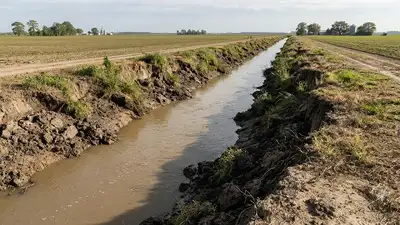
Two Louisiana lumber firms lose case over canals they said widened and damaged their land. (AI image)
The dispute began in 1952, when both lumber companies allowed SNG to build a pipeline across their properties. Their agreements permitted the company to dig canals up to 40 feet wide. In 1970, the companies signed revised agreements allowing SNG to shift the pipeline route and install a second pipeline. The permitted canal width was also increased from 40 feet to 65 feet. They filed a lawsuit in September 2018, seeking compensation for the loss of land and other damage. A trial court accepted this argument in May 2025 and dismissed the lawsuit. The lumber companies challenged that decision, but the Louisiana Court of Appeal upheld it in a ruling dated November 6. The company could dig them up to 40 feet wide and had to spread the removed soil evenly across the land. The 1970 agreements allowed SNG to widen the canals. The company could add another 25 feet on the eastern side of the White Castle property and 20 feet on the eastern side of the Jeanerette property. It concluded that any breach of the agreements would have happened when the canals were originally dug in 1953 or widened in 1970. Under Louisiana law, such claims generally have to be filed within 10 years of the alleged breach. Since the lumber companies filed their case in 2018, the court said the deadline had already passed. SNG told the court that it had done no further work on the properties after the canals were extended in 1970. Since that work had ended by 1970, the continued erosion could not be treated as a fresh violation every year. The lumber companies also argued that they understood the full extent of the damage only in 2017, after hiring experts to examine their properties. Aerial photographs showed that the canals had widened beyond the agreed limits by 1957 and 1970. The companies also knew by 1960 that the original canal had grown from its permitted width of 40 feet to 53 feet.
Because of erosion, eating into their land and affecting its drainage, they claimed that the canals had widened over the years. They said the gas company therefore had a continuing responsibility to maintain the canals and prevent damage to their land. Because the damage to their land had continued over the years, the lumber companies argued that their claims should still be considered. The court therefore rejected the companies’ argument that the continuing damage allowed them to file the case in 2018. Because of erosion and had allowed other companies to dig canals on their properties, they also knew that canals could widen. The dissenting judge wanted the case returned to the trial court so that the alleged maintenance failures and the resulting damage could be examined further.
Two Louisiana lumber companies have lost a legal battle against a natural gas company over canals that they said had gradually widened and damaged their land. The agreements signed by the two lumber companies did not contain similar conditions.
White Castle Lumber & Shingle Company and Jeanerette Lumber & Shingle Company had accused Southern Natural Gas Company (SNG) of failing to maintain canals dug through their properties for a gas pipeline, according to the judgment document. They said erosion caused the canals to become wider, resulting in land loss and changes to water movement and drainage. The court said it could not create an additional responsibility that was not included in the agreements. However, the court said that continuing damage does not automatically mean that a company is still committing a wrong. The judges said the digging of the canals was the action that caused the alleged damage. They said they had not known that the canals’ widening had affected water movement, drainage and other natural conditions of the land. The companies regularly inspected their properties by boat, according to the evidence presented by SNG. The judges said landowners do not need to know every detail of the damage before the time limit for taking legal action begins. It said they had not shown why they could not reasonably have discovered the problems earlier. Judge Miller disagreed with the majority and said the case should be sent back to the trial court for further examination. The judge said SNG’s responsibility to maintain the pipeline right-of-way continued while the agreements remained active. Judge Miller said the majority had focused too much on the original construction work instead of examining whether SNG had failed to maintain the canals later.
They also required it to spread the excavated soil evenly and ensure that the work did not block water from draining from nearby land. The lumber companies later claimed that the canals had grown beyond the agreed limits and that SNG had failed to prevent the damage. The two lumber companies own land across Iberville and Assumption parishes in Louisiana. Under the original agreements, SNG was allowed to construct, operate, repair and replace pipelines on their properties. The agreements also set limits on the size of the canals. Its work was not supposed to interfere with the drainage of nearby areas. The lumber companies claimed that SNG did not properly maintain the canals and their banks. They also alleged that the damage affected the land’s natural conditions, including its water flow and the movement of sediment. Their lawsuit included claims of negligence, trespassing, nuisance and breach of the agreements. They also sought action under Louisiana’s consumer protection law. The lumber companies argued that the agreements were still active. The court disagreed. It found that the agreements required SNG to maintain its pipelines but did not specifically require it to maintain the open canals or prevent erosion. They found that some agreements in those cases had clearly required pipeline companies to pay for damage caused by the construction, use and maintenance of canals. They also did not promise compensation for all damage caused by the widening of the canals. For a case to be treated as a continuing wrong, the accused company must keep carrying out unlawful actions that cause damage. The lumber companies also did not present evidence showing that the company had carried out additional work. Their employees also used the gas company’s canals to move around and examine the land. The court further noted that the companies were aware of drainage problems from the 1970s. They only need enough information to make them investigate a possible problem. The court found that the lumber companies had enough information to look into the damage decades before filing their lawsuit. The appeals court’s decision was not unanimous. The lumber companies were not only complaining about the original digging of the canals. They were also claiming that erosion and the gradual widening of the canals had changed water movement and drainage on their properties over time. The judge also pointed out that the case had been decided on whether the lawsuit was filed too late. It had not gone through a full trial examining all the allegations. The two lumber companies were also ordered to pay the costs of the appeal. You use AI every day. Now get your AI Quotient. Take the AIQ test.
An appeals court has upheld an earlier decision dismissing their lawsuit, saying they waited too long to take legal action. However, SNG argued that the alleged damage had started decades earlier and that the companies had missed the deadline to file a case. One of the main questions before the appeals court was whether SNG was required to keep the canals from widening and causing erosion. The judges also examined earlier court cases involving similar disputes. The effects of an earlier activity continuing over time are not enough. The court, however, found that the companies had information about the problems much earlier. However, the majority upheld the earlier decision dismissing the lawsuit.