
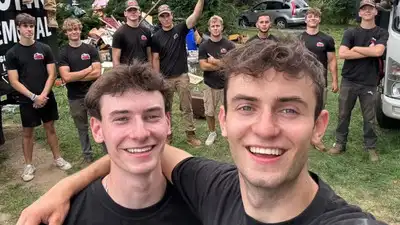
Because their parents run a local tree service company, the brothers had some business experience at home.
The brothers launched Junk Teens in February 2021 in Norwood, Massachusetts. Kirk was 17 and Jacob was a high school freshman. The company generated $3.04 million in revenue in 2025. The brothers then bought a used 2006 Ford F-150 pickup truck for $4,000 of their own money. The company completed more than 5,500 jobs in 2025, mostly residential and commercial junk-removal work. The brothers said they generally charge $300 to $600 per job, depending on its size and the service required. Junk Teens now has 10 full-time employees and about 10 to 15 part-time employees. The brothers plan to add two more dump trucks later in 2026. In 2025, each paid themselves salaries in the low-to-mid six figures. The company now has more than 400,000 combined followers on Instagram and TikTok. In March 2023, Junk Teens began renting warehouse space for $1,450 a month. Junk Teens crossed $1.2 million in revenue in 2024, Jacob’s final year of high school. In 2025, they used marketing software, promoted employees into leadership roles and opened their second location in the Cape Cod area. The brothers said these changes helped Junk Teens more than double its annual revenue and almost double its annual profit in 2025.
Because their parents run a local tree service company, the brothers had some business experience at home. Because local dumps operated during school hours, during his senior year, he negotiated a block of midday free time with his guidance counsellor. Because of what he has learnt at college, he stayed, partly for his parents and partly.
Kirk was a teenager when he found a pair of working speakers at the dump and became interested in finding and reselling unwanted items, CNBC reported.
I just kept going back to the dump and, eventually, my bedroom looked like a mini hoarder’s house,” Kirk said. Kirk said he met people at the dump who were willing to pay local teenagers to remove unwanted items from their homes. “We didn’t really know that we wanted to start this business,” Jacob said. “The money is great, but that’s not what the whole point of this is,” Kirk said. Kirk said this gave them an early understanding of administration and bookkeeping. “One thing that we were very fortunate for is growing up in a family business background,” he said. “We grew up watching our parents do all of that stuff for their business, and we would ask them questions in the beginning,” Kirk added. Kirk said they searched for “how to start a junk removal business” and learnt about setting up the legal structure and putting aside money for taxes. Jacob said they became “really crafty” with their time. Kirk said they would ask teachers for forgiveness when they were late for class. The company nearly cleared six figures in profit during its first year, Kirk said. “Our parents were not happy with that,” Kirk said. “Being a seven-figure business-owner in high school felt pretty crazy,” he said. The brothers now focus mainly on administration and strategy and have not gone “into the field” in nearly two years, Jacob said. Kirk said he has considered dropping out of college three times to focus on Junk Teens full-time. “College has taught me things that business never will,” he said, referring to social and communication skills. “I have a really strong feeling that after college, things are going to take off more than they ever have,” Kirk said.
A bike ride to a local dump led Massachusetts brothers Kirk and Jacob McKinney to start a business that has grown into a multimillion-dollar junk-removal company. “I was hooked. He began selling items found at dumps and on Facebook Marketplace as a side business. His interest in discarded items soon connected with a local demand for junk removal. He left his grocery store job and asked Jacob to join him. They initially took on other jobs, including landscaping and moving work. Junk removal and reselling eventually became the part of their work they found most enjoyable and profitable. Customers also showed interest when they learnt that Junk Teens was repurposing items instead of simply removing them. The business grew from its early pickup-truck operation into a company with five dump trucks and two locations in eastern Massachusetts covering Boston and the Cape Cod area. The workers are high school students, college students or people taking gap years. Kirk and Jacob are also studying entrepreneurship at Babson College while running the company. Some of that money went towards their college tuition, while their parents covered the rest. “We want to build futures for our friends, and we want to do what we love and not have to work at a job that we hate. The brothers also used YouTube to learn how to run the company. Junk Teens later began posting its own instructional videos, including content about negotiating prices and deciding whether items should be disposed of, flipped or donated. In the early days, the brothers worked around their school schedules. They sometimes handled only one or two jobs a week after school or at weekends. As the company grew, they hired friends, gave up hobbies such as playing video games and changed their schedules. The brothers sometimes parked their dump truck in the school car park. The brothers then bought their first dump truck and kept it and their pickup in their parents’ driveway. They also stored electronics, appliances, furniture and bicycles under a tarp. Running the business while studying remains difficult. “And life isn’t all about making money and having a successful business. Catch the latest World News and Live updates. Download the TOI app.
The company is targeting $5 million in annual revenue by the end of 2026. Junk Teens plans to expand across the rest of Massachusetts before eventually moving into other parts of the East Coast. The brothers are also open to franchising the business, bringing in outside investors or selling it in the future, although none of those options is part of their immediate plans.