
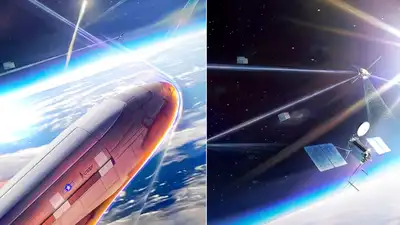
US reveals it has placed weapons in space
India is a more distant and quiet fourth entrant to the space club, having announced its arrival in the counterspace arena in March 2019 with Mission Shakti, when it destroyed an Indian satellite in low-Earth orbit with a hit-to-kill interceptor. Its 2025 SpaDeX mission demonstrated autonomous docking and undocking – a technology with peaceful applications such as satellite servicing but obvious future military utility as well.
New Delhi said at that time the ASAT test demonstrated the country’s ability to defend its space assets. Having demonstrated a credible Anti-Satellite (ASAT) capability, it is advancing rapidly in launch, docking, surveillance and space situational awareness, but its military space architecture remains substantially smaller. DRDO lists work involving space-based lasers, satellite jamming, electronic intelligence, rendezvous and proximity operations and space-based surveillance, moving the country toward a more sophisticated space-security architecture, while continuing to advocate negotiations to prevent an arms race in outer space. So although Russia remains highly capable in selected counterspace areas and China is the fastest-rising challenger, with India somewhere in the periphery, the US remains the most comprehensive space power. It has unmatched breadth: military satellites, intelligence, navigation, missile warning, launch capacity, enormous commercial infrastructure and an increasingly resilient constellation architecture. Its commercial space sector gives Washington another advantage: it can replenish and augment military capabilities through private companies.
Since then, India’s emphasis has increasingly included space situational awareness, satellite protection and sophisticated orbital operations rather than simply blowing things up.
China reacted quickly to the development on Tuesday, urging Washington to stop “preparing for war” in outer space and warning against turning the heavens into a battlefield or triggering a new arms race. Russia likewise called for space to remain free of weapons and pressed the case for preventing its militarisation. Both countries have substantial counterspace programs of their own. China has demonstrated direct-ascent anti-satellite technology and has developed increasingly sophisticated satellites capable of rendezvous and proximity operations. Russia remains a formidable counterspace power, particularly in electronic warfare, proximity operations and anti-satellite technology, although its broader space program has suffered from economic pressures, isolation and declining launch activity.
The foundation’s 2025 assessment says the US already had at least one offensive counterspace system deployed and was believed to have another; both were identified as jammers. The 1967 Outer Space Treaty prohibits nuclear and other weapons of mass destruction in orbit, but does not ban conventional weapons. Because a kinetic weapon that smashes a satellite can create thousands of pieces of debris moving at extraordinary speed, potentially threatening other satellites and spacecraft, the distinction matters enormously. Because satellites are omnipresent now: communications satellites connect billions of people, they can cause immense casualties on Earth without a single explosion or a missile striking a city. The legal door was therefore never quite as firmly shut as the diplomatic rhetoric suggested.
“The United States now has on-orbit space control weapons capable of defending the joint force against hostile adversary action,” US Air Force Secretary Troy Meink revealed at an Air, Space & Cyber Conference near Washington, setting off concern across the world. Today’s “We’ll be damned” may well become tomorrow’s “We’ll be jammed. ” America’s journey from moonshot to slingshot in space was not unexpected. So the compact has now been gently broken, with the US announcement raising a paradox worthy of a Cold War cartoon: everybody says they want to prevent a space arms race, while donning running shoes.
TOI correspondent from Washington: Space war has just come out of the closet. For the first time, the United States has publicly acknowledged that it has weapons stationed in orbit, a development that confirms what space-security experts have long expected: the earth is no longer the limit; the skies will be the newest place to park weapons. Meink pointed to the counterspace capabilities being developed by China and Russia to assert the purpose behind the US deploying space weapons is deterrence and protection. Moscow and Beijing, and possibly New Delhi, are expected to play catch-up soon. Nobody outside classified circles knows precisely what Washington has placed in orbit. Possible counterspace weapons include jammers, systems capable of dazzling or disrupting sensors, cyber capabilities and, more controversially, kinetic weapons that can shoot and destroy satellites. Some experts believe non-kinetic systems such as jammers are more likely to have been deployed. Victoria Samson, chief director of space security and stability at the Secure World Foundation, has suggested that the newly acknowledged American systems could be space-based jammers. But even jammers can be lethal. Weather satellites help warn populations of hurricanes and other disasters. GPS supports aircraft, ships, emergency services and financial networks. For six decades, Washington had maintained a familiar diplomatic fiction about the skies: space was becoming militarily important, but the US will not be the first to put weapons there. Russia, and more recently China, likewise essayed similar platitudes. The immediate consequence of the American announcement though may well be psychological rather than kinetic. Some experts believe Monday’s disclosure was a deliberate attempt to seize the technological high ground after recent setbacks in terms of advances made by China and Russia in weapons development. But Beijing and Moscow are eventually expected to point to Washington’s own admission when justifying further counterspace investments, heralding the arrival of another arms race – this time in the skies. Catch the latest World News and Live updates. Download the TOI app.
One small disclosure from Washington on Monday is expected to lead to a giant leap for humankind – towards an arms race in the skies.