
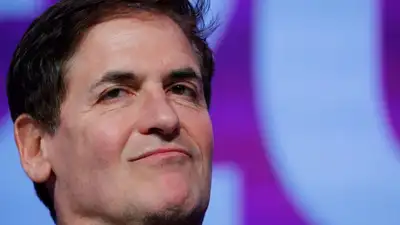
Mark Cuban
Faced with mounting educational costs, Cuban kicked off the network by approaching an initial participant and asking for $100 upfront, structuring an informal financial pyramid: Cuban collected $100, pocketed $50 immediately and directed the remaining $50 to the dorm resident whose name sat at the top of a 10-person list. The top name was removed, and the new payer’s name was added at the bottom, creating a $50 circulating chain letter. As the chain expanded through the dorms, envelopes stuffed with $50 contributions began arriving steadily at his mailbox, covering his college tuition and living expenses for the year. His father, who worked in automotive upholstery, occasionally handed him a $20 bill, but taught him early on to fund his own desires.
Because i’d go to [my mailbox] and there’d be envelopes with 50 bucks from here, 50 bucks from there, and that’s how I paid for my junior year of college,” Cuban admitted with a chuckle during the podcast appearance, and it was amazing,. That conversation launched Cuban’s sales career at an early age.
Speaking on the San Francisco Standard podcast recently, the 68-year-old billionaire entrepreneur opened up about how he financed his junior year of college at Indiana University in the early 1980s: by launching a dorm room “chain letter” that he now candidly admits operated as a ‘scam’. After graduating from college, Cuban relocated to Dallas, where he shared a cramped apartment, which he and his roommates dubbed a “hell hotel”, with five other young men. Mark Cuban relied on unconventional college hustles just to stay enrolled. Long before rising to fame as a celebrity investor on Shark Tank, owning the NBA’s Dallas Mavericks and joining the ranks of the world’s wealthiest individuals, Cuban ran a ‘Ponzi’ scheme. “It was basically a scam. I made sure my friends all got their money back. And so I got up to the top of the list. As successive students paid in and recruited others, names moved higher on the list until participants reached the top slot, theoretically collecting cash from incoming buyers. Cuban pitched the scheme as a way for participants to walk away with more cash than they put in. Finding resourceful ways to earn cash was nothing new for Cuban, who was raised in a working-class household in suburban Pittsburgh. When a young Cuban asked his father for a new pair of basketball shoes, his father replied that once he had a job, he could purchase whatever he wanted. Taking advantage of an opportunity through a family friend who had surplus boxes of trash bags, Cuban began knocking on doors throughout his neighborhood to sell household supplies. “I would go door-to-door to be like, ‘Hi, my name is Mark. Do you use trash bags? I killed it. Cuban recalled.
Cuban slept on the floor, took a bed only when a roommate went out of town, and owned neither a closet nor a dresser. To make ends meet, he worked as a software salesman while spending his spare time reading tech manuals to master computer programming and operating systems. You use AI every day. Now get your AI Quotient. Take the AIQ test.