
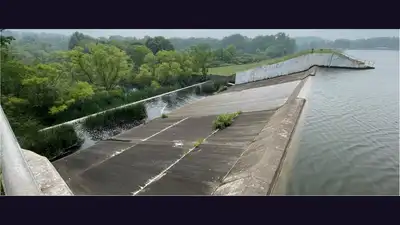
PC: Ohio Department of Natural Resources
Ohio has lowered Guilford Lake by 20 feet as part of a $14 million dam rehabilitation project to address structural deficiencies and meet modern safety requirements. Construction was reported to be on schedule in June 2026, with the lake expected to begin refilling in winter 2026–27 and reach normal levels by spring 2027, weather permitting. The dam has undergone several major interventions since its original construction, including a full reconstruction in 1933 and modifications in 1957, 1968 and 1983. The Ruhlin Company was approved as the contractor after bids for the project were opened on 23 October 2025. ODNR reported that the project would cost approximately $14 million and that the state’s Controlling Board had approved the contractor and released the funding.
Because it may be unsafe as water levels change, vehicles are not allowed on the exposed lakebed, and the department has warned visitors to avoid ice.
The reservoir reached full drawdown during preparations for construction, which includes replacing the existing spillway and improving the dam’s drainage system and embankment stability, according to the Ohio Department of Natural Resources (ODNR). ODNR said the dam’s embankment had insufficient safety factors for seepage and stability, while its internal drainage system had reached the end of its design life. The work is intended to help the dam safely manage major flood events and protect downstream communities. The rehabilitation follows engineering evaluations that identified deterioration in the dam’s concrete spillway, including separation at its joints. The existing spillway also lacked sufficient capacity to safely pass the Probable Maximum Flood (PMF), the largest flood considered in the project’s design requirements. The department stated that addressing these deficiencies was necessary to protect downstream communities and preserve Guilford Lake as a recreational resource. The current rehabilitation is designed to bring the structure into compliance with modern dam safety regulations and prepare it for continued service in the coming decades. Construction preparations included establishing a field office, installing perimeter fencing and signage, and putting erosion controls in place. A cofferdam made from sheet piling and water-control measures were also installed to allow the existing spillway to be demolished. Public access to the construction site remains prohibited, although the state park campground remains open. ODNR has stated that fishing is permitted outside the construction area, but swimming is prohibited throughout the lake. The construction site is being monitored remotely, and periodic photographs of progress are available through the Guilford Lake State Park Facebook page.
How will Ohio’s new spillway improve Guilford Lake Dam safety
In its June 2026 update, ODNR reported that the existing spillway demolition had been completed and concrete had been poured for both the upper and lower cutoff walls of the new spillway. Substantial completion of construction is anticipated in winter 2026–27, when the lake is expected to begin refilling, according to the project schedule published by ODNR. The department has identified spring 2027 as the target for completing the refill, subject to weather conditions.
The design is intended to maintain the lake’s normal pool elevation once the reservoir returns to its usual operating level, according to ODNR. The rehabilitation includes a new labyrinth spillway designed to pass the Probable Maximum Flood without overtopping the dam’s embankment. It is also intended to keep downstream discharges during significant storm events consistent with pre-rehabilitation conditions. Work on the embankment involves excavating the existing structure to install a modern drainage and filter system with monitoring capabilities. The embankment will then be rebuilt and reinforced with additional material at its downstream toe. Installation of a new toe drain had also begun on the eastern side of the spillway, while the stilling basin at the base of the structure was the next component scheduled for concrete work. ODNR does not anticipate long-term road closures, with most of the work expected to be accessed through the southeastern entrance Although the lake will remain closed to the public during construction. The rehabilitation is intended to address the dam’s identified safety deficiencies while restoring the reservoir to its normal operating level. You use AI every day. Now get your AI Quotient. Take the AIQ test.