
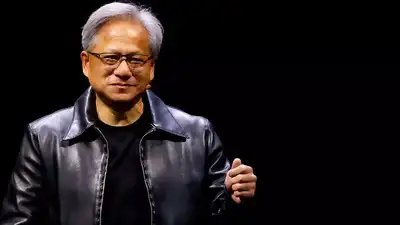
Nvidia CEO Jensen Huang
Nvidia CEO Jensen Huang dismissed concerns over a memory chip glut, saying that a supply surplus is unlikely to materialise by 2029, even as memory stocks tumbled over the past week on fears of cooling artificial intelligence (AI) demand and an increase in RAM production. The recent sell-off in semiconductor and memory equities followed an October 15 opinion column in a popular South Korean publication warning policymakers in Seoul to prepare for a slowdown in the AI-driven market boom.
“One of the things that’s really great about memory is that you can always use more of it,” Huang said, underscoring that High Bandwidth Memory (HBM), which is a specialised form of RAM critical for AI acceleration, will continue to see widespread use for years to come. “We’re the first company in the world to put LPDDR memory – what goes into your cell phones – into the world’s data centers, and it’s enabled us to deliver performance that’s twice as energy efficient as anything in the world today, and so we’re going to continue to use abundant amounts of them as well,” he added. The claims also drew attention from Tesla and SpaceX CEO Elon Musk, who weighed in on social media to note that China “will be making a LOT of RAM in 2028”, after China’s ChangXin Memory Technologies (CXMT) unveiled a new design architecture, sparking fears that the domestic Chinese producer could chip away at the market share commanded by Samsung, SK Hynix and Micron.
Speaking to CNBC on the sidelines of Nvidia’s GTC Berlin conference, Huang pushed back against market speculation that the ongoing hardware supercycle is nearing an abrupt end. Huang also highlighted Nvidia’s architectural shift toward integrating low-power memory into massive compute clusters. As memory forms an important backbone of Nvidia’s accelerated hardware, any severe oversupply could erode pricing power and compress margins for top global fabricators, including SK Hynix, Samsung Electronics and Micron Technology.