
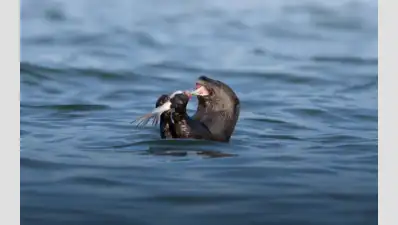
The otters are listed as vulnerable by the International Union for Conservation of Nature (IUCN) and safeguarded under Schedule I of India’s Wildlife Protection Act, 1972
The fisherfolk of Anaikarai village call them meenakutty (derived from ‘meen-naai-kutty’ meaning fishing puppies) for the way they playfully sneak up on them and steal their morning catch, almost like a cat-and-mouse game. Scientists, however, do not see it that way. What they see is a growing conflict between people and the smooth-coated otter (Lutrogale perspicillata), a vulnerable species, the largest of the species in Asia, struggling to survive in Tamil Nadu ’s dwindling rivers.
On March 28, during a state assembly session on endangered species protection, the Tamil Nadu Department of Forests unveiled several conservation programmes.
“These conflicts are what the forest department hopes to curtail with its four-stage programme,” says Supriya Sahu, additional chief secretary, environment, climate change and forests. Based on the study’s results, we will strengthen conservation efforts including habitat management, community involvement, and ongoing research and monitoring,” she says. Among them was one for smooth-coated otters: the ‘Conservation initiative to study the population dynamics, behavioural pattern, and habitat improvement of smooth-coated otters in Thanjavur, Thiruvarur, and Cuddalore districts, within the Cauvery River delta’. This effort seeks to estimate otter numbers, map vital habitats, investigate threats such as pollution and human conflict, and implement recovery actions, such as planting reeds and building fish ladders. Led by the forest department’s research division, the Advanced Institute for Wildlife Conservation (AIWC) in Vandalur, Chennai, will conduct the study through the department of wildlife biology at AVC Autonomous College in Mayiladuthurai in the Cauvery delta region. The institute’s scientists plan to survey and research otter groups in Thanjavur, Tiruvarur, and Cuddalore districts for a year. The forest department will supervise the research and apply the results to advance conservation. Otters are usually monitored through direct observations, faecal sample analysis, photographic records, and environmental DNA sampling, say forest department officials. The Endangered Wildlife and Environmental Trust (EWET) has performed field surveys and habitat mapping throughout the delta to safeguard and track otter populations. They also run awareness programmes to inform students and locals about the ecological role of otters and the need to preserve their environment. In the first stage, the distribution and population status of smooth-coated otters in the Cauvery delta will be assessed, and essential habitats will be ranked for protection. Next, human-otter conflict will be studied, after which population changes and behavioural ecology will be looked at. “The final stage will involve habitat restoration and conflict reduction strategies at certain locations.