
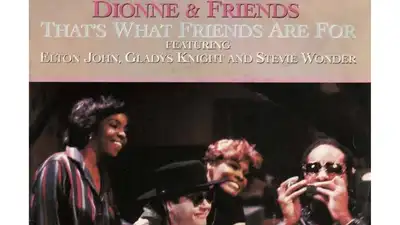
In 1985, as the AIDS epidemic spread and fear and misinformation surrounded the disease, four of the biggest names in music came together to record a song that would become a landmark charity hit. Released under the name Dionne & Friends, the single became a major commercial success, eventually raising millions of dollars for the American Foundation for AIDS Research, known as amfAR. Dionne Warwick, Elton John, Gladys Knight and Stevie Wonder joined forces on That’s What Friends Are For, turning a song about friendship and support into a fundraising effort for AIDS research. It also earned major Grammy recognition, giving the campaign a reach far beyond the recording studio.
The single was released in 1985, at a time when public understanding of HIV/AIDS remained limited and the need for research funding was urgent. The first recognised cases in the US were reported in 1981. A significant scientific milestone came in March 1985, when the US Food and Drug Administration approved the first commercial blood test to detect HIV. The recording raised approximately $3.4 million for AIDS research, according to the Recording Academy’s retrospective on Bacharach’s career. Other accounts describe the total more generally as more than $3 million. The money supported amfAR, an organisation established in 1985 that became a prominent funder of AIDS research and an advocate for people affected by HIV/AIDS.
The project was supported by Bacharach, Bayer Sager and record executive Clive Davis, with proceeds directed towards AIDS research. In the early 1980s, AIDS had become a growing public-health crisis, but the disease was still widely misunderstood. Researchers were working to understand the virus, develop diagnostic tools and identify effective treatments, while people affected by the epidemic often faced discrimination and social isolation. The test helped identify infections and made it possible to screen donated blood more effectively. However, effective long-term treatment remained unavailable, and the epidemic continued to claim lives. Against this backdrop, a charity recording featuring four internationally recognised performers helped bring AIDS research to a much wider audience. Its impact extended beyond its message: the commercial success of the single generated substantial funds for research and helped keep the cause in the public eye.
The awards cemented the recording’s place in popular music history. But its legacy was not limited to chart positions or industry recognition. The song became closely associated with a moment when artists used their collective influence to support AIDS research at a time of immense uncertainty. The significance of That’s What Friends Are For lies in the combination of its message, its star-studded collaboration and its fundraising impact. The recording did not solve the AIDS crisis or directly produce a medical breakthrough, but it helped finance research and raise awareness when both were urgently needed.