
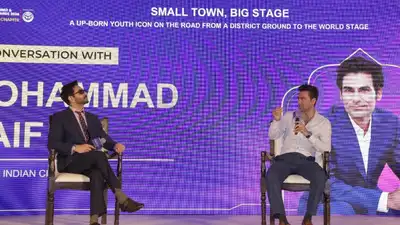
For Mohammad Kaif, the road to international cricket began far away from the glamour of packed stadiums and television cameras. It started with long days of practice, limited resources and the determination to make a name for himself.
Speaking at the Times of India Indian Youth Awards 2026 in Prayagraj, the former Indian cricketer reflected on his journey from Uttar Pradesh to the world stage. Kaif, who captained India to victory at the Under-19 Cricket World Cup in 2000, recalled how difficult it was for young players from smaller cities to find opportunities when he was starting out. At just 12 years old, he began moving between hostels in Kanpur to pursue cricket. Recalling his experience, Kaif said that sponsors approached him in 2007, after his achievements had already brought him into the spotlight. Chasing 326, India recovered from a difficult position through a remarkable partnership between Kaif and Yuvraj Singh. Kaif remained unbeaten on 87 as India won by two wickets.
Comparing his early years with the opportunities available in states such as Maharashtra and Karnataka, Kaif said that access to facilities was more difficult in Uttar Pradesh at the time. Such reactions, he said, showed how difficult it was for people from smaller cities to break into professional sport. “From smaller cities your hunger is much more,” Kaif said during the conversation, explaining how having fewer advantages pushed him to work harder.
The session, titled Small Town, Big Stage , was moderated by actor Aparshakti Khurana. He had to learn to manage challenges while continuing to work towards his dream. He also recalled that people were sometimes surprised to see a cricketer emerging from Uttar Pradesh. But the lack of resources also gave him a strong desire to succeed. Kaif’s journey also reflects the changes that have taken place in Uttar Pradesh cricket over the years. When he began playing, young cricketers often had to make their own way through limited facilities and opportunities. He spoke about how financial support and sponsorship often arrive only after a sportsperson has achieved recognition. He questioned why talented players do not receive more support while they are still trying to establish themselves. For young athletes, the difference between having talent and making it professionally can depend on access to coaching, equipment, travel and financial backing. Kaif’s remarks highlighted why early support can be crucial for players who come from families with limited means.
His family did not have access to the kind of resources that many aspiring sportspersons have today. Today, he believes the situation has improved, although the need to support players early in their careers remains important.
You Can Also Check: Gold Rate in Lucknow | Silver Rate in Lucknow | Bank Holidays in Lucknow | Public Holidays in Lucknow | Lucknow AQI | Weather in Lucknow | Petrol Price in Lucknow | Diesel Price in Lucknow | CNG Price in Lucknow | LPG Price in Lucknow Stay updated with the latest Lucknow news. From a young boy moving between hostels in Kanpur to an international cricketer who helped India win memorable matches, Kaif’s story is a reminder that opportunities matter, but so do persistence, belief and the courage to keep working towards a goal. Download the TOI App.
One of the important moments discussed during the session was Uttar Pradesh’s Ranji Trophy triumph in 2005–06, when Kaif captained the team to its first title. Kaif’s career included several memorable moments, but India’s historic NatWest Series final victory against England at Lord’s in 2002 remains one of the most celebrated.
Kaif said he had repeatedly expressed his view that Zaidi had the ability to achieve much more if given the chance. “One match can change your career,” was one of the key messages from his discussion. He said that people who work hard deserve a chance to prove themselves.
He explained that winning creates belief among players and helps a team develop a stronger mindset. The victory also brought attention to the talent available in the state. Kaif recalled the contributions of players such as Suresh Raina, who scored a century in the final, and Praveen Kumar, whose performances during the season helped the team. He also spoke warmly about fellow Uttar Pradesh cricketer Ashish Winston Zaidi, whom he believed deserved more opportunities. The discussion also touched on players such as Piyush Chawla, Rudra Pratap Singh and Bhuvneshwar Kumar, who went on to represent India. For Kaif, the larger lesson was that a successful team can inspire an entire generation. When young players see someone from their own region succeed, they begin to believe that they can do the same. He recalled how players of his generation looked up to cricketing heroes such as Sachin Tendulkar, Kapil Dev and Gautam Gambhir. Reflecting on the pressure of big matches, he explained that a player needs a clear mind and a strong sense of what they want to achieve. He also described life as a roller coaster, saying that challenges do not disappear after success. Players must keep fighting through different stages of their careers. His own experiences, from travelling to practice as a youngster to performing under pressure at major venues, taught him the importance of fitness, discipline and mental strength. Towards the end of the session, Kaif was asked about the importance of giving players opportunities. He also reflected on the changing relationship between coaches and players. Recalling his early days at Madan Mohan Malaviya Stadium, where he travelled by bicycle to practise, he spoke about the respect he had for his coach and the lessons he learnt through daily training. For Kaif, success is not only about talent or access to facilities. It also depends on discipline, the ability to learn and the determination to keep going when circumstances are difficult. His journey offers a powerful message to young people attending the Indian Youth Awards in Prayagraj: where you begin does not have to decide where you end up.