
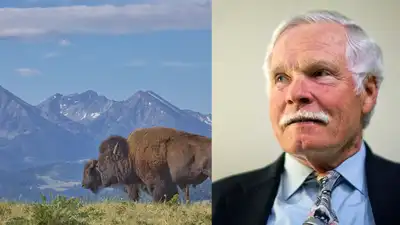
PC: Turner Institute of Ecoagriculture/Forbes
Ted Turner transformed his 113,613-acre Flying D Ranch in Montana after buying the property in 1989, replacing domestic cattle with a managed bison herd and pursuing a different approach to wildlife conservation. The property now supports around 4,500 bison, while grassland restoration, forest management and stream conservation form part of a wider effort to protect its wildlife habitat. Turner purchased the 113,613-acre Flying D Ranch near Bozeman in 1989. Grizzly bears also pass through the ranch, while seasonal elk herds can number more than 2,000. Ranch staff have treated more than 3,000 acres of timber to limit damage associated with mountain pine beetle infestations. Conservation partners have restored or protected more than 70 miles of connected stream habitat in local watersheds.
Working with biologist Mike Phillips, he allowed the wolves to remain and instructed his staff not to shoot them, even if they preyed on the ranch’s animals, as reported by Montana Free Press.
When wolves dispersing from Yellowstone National Park established a presence on the ranch, Turner made an unusual decision for a working livestock operation: he instructed his staff not to shoot the predators, even if they killed bison, according to Montana Free Press. The property supports nearly all the large native mammal species found in the contiguous United States, with the Canada lynx the exception, according to Turner Enterprises. The property lies between the Gallatin and Madison river systems, an area of open grassland, forest and waterways that forms part of a much larger landscape used by wildlife. After acquiring the ranch, Turner removed its domestic cattle and established a managed bison herd. The animals continued to be raised within a working agricultural operation, rather than being left entirely to their own devices. Montana classifies bison as livestock, so the ranch still requires fencing and active management of grazing areas. Turner chose a different course. The decision did not remove the practical difficulties of keeping predators and livestock on the same property. Instead, it meant that the ranch would accept a degree of risk rather than respond to wolf activity by killing the animals. That policy gave biologists an opportunity to observe how wolves behaved in a landscape where a working bison operation continued alongside them. The wolves established a pack known as Beartrap, which eventually became one of the larger packs in the region. Montana Free Press noted its presence drew the attention of wolf researcher Val Asher and other visiting scientists interested in predator behaviour outside the boundaries of a national park. A privately managed ranch offers a different setting from Yellowstone’s protected interior. Wildlife must share the landscape with agricultural activities, fencing and other forms of human land use. Observations at the Flying D helped scientists examine how wolves occupied territory and interacted with a managed bison herd under those conditions. Wolf management formed only one part of the Flying D’s wider land-management programme. The property supports a range of native mammals, including elk, moose, mule deer, white-tailed deer, pronghorn, black bears and mountain lions. The variety of animals reflects the different habitats across the ranch, from open grasslands to wooded uplands and river corridors. Management work extends into the forests. Prescribed burns are also used to help prevent conifers from spreading into open grassland, where changes in vegetation can affect habitat and grazing conditions. Waterways have received attention as well. The work benefits native fish, including westslope cutthroat trout and Arctic grayling. The ranch also maintains a reservoir used to raise Arctic grayling for reintroduction into Montana rivers, contributing to efforts to recover the species. Bald and golden eagles are among the birds that use the river corridors. Taken together, the ranch’s grassland, forest and stream projects form a management programme that reaches well beyond the question of whether wolves should be allowed to stay. You use AI every day. Now get your AI Quotient. Take the AIQ test.
The herd has since grown to approximately 4,500 animals, according to the Turner Institute of Ecoagriculture. More than 5,000 acres of previously cultivated land have been restored to native grazing habitat, according to information about the property’s conservation work. The return of wolves to Yellowstone National Park in 1995 brought a new element to the management of surrounding ranchland. By 2002, wolves dispersing from Yellowstone had established a presence on the ranch.
Ranch management has also included efforts to return former farmland to native grassland. The land itself has protection against future development. Turner placed the ranch under a conservation easement held by The Nature Conservancy, restricting certain forms of development and helping preserve open space and wildlife movement across the region. The easement is among the largest of its kind in Montana. As the animals spread beyond the park, some established territories on neighbouring properties, including the Flying D. For a commercial livestock operation, their arrival presented a familiar problem: predators could kill animals that had financial value to the owner. Removing the wolves was an option available to many landowners, depending on the applicable wildlife regulations.