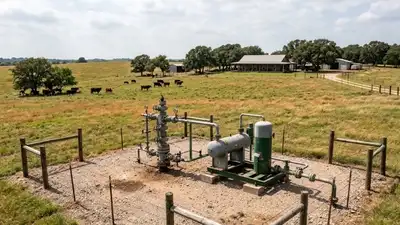
AI-generated representative image showing natural gas production equipment on a Texas ranch, illustrating how land used for farming can also hold valuable mineral resources. Credits – Gemini
His mother, Roberta Hudson Lindsey, received her first royalty check for $600,000. Max Lindsey’s own largest monthly royalty payment later reached $40,000, according to a 2012 report by The News Outlet, republished by The Vindicator. The family owned 170 acres near Rhome, Texas, and had held the property since 1850. Lindsey’s relatives settled in Texas after mining for gold during the California Gold Rush, according to the 2012 report. The money began flowing roughly a decade before Lindsey told the story in 2012, when his mother was already in her 80s.
Because drilling never commenced, for decades, the deal had yielded no apparent financial advantage. The answer was that his parents had signed a contract in the mid-20th century allowing gas drilling on their farm. Something significantly more important than the amount owed can be found on a standard tax statement. A Texas landowner named Max Lindsey made a revelation that changed his family’s financial situation after seeing a business name on his mother’s documents. The family had not received much information about the potential value of their property, which had been subject to a gas drilling agreement for decades. Lindsey started phoning and looking into the business mentioned in the statement. He discovered that the mineral rights his parents had committed to lease many years prior were producing a sizable revenue and that gas was being produced from the family’s land. The discovery brought substantial income to a family that had spent generations farming and raising cattle on the same property. The clue hidden in the paperwork Lindsey was doing his mother’s taxes when he saw the name of a production business on an oil well tax statement. Rather than file it away in the cabinet, he went online, found the company’s manufacturing office and called them. The family continued to farm and raise cattle, at times having difficulty meeting household bills. The account does not specify exactly when they made the journey or when they acquired the land. Despite owning the property, the family had limited cash, and Lindsey’s father once drove a school bus to supplement the household income. His mother maintained a garden and canned food for family meals. The contrast between these financial difficulties and the later royalty payments was striking. She was getting checks in the mail, he continued, but she didn’t quite understand what they meant. Why an old gas lease became valuable
Energy Information Administration’s explanation of shale gas production identifies the Barnett Shale as a major starting point for large scale commercial shale gas production around 2000. Most of the wells on his family’s land were producing at 12.5% for them, Lindsey added. Some later leases signed by family had an 18.75% royalty. He’d retired from his work as a machinist at Lockheed Martin around 10 years ago and was also on Social Security. The initial cheque for $600,000 and the ensuing monthly payments of up to $40,000 transformed the family’s situation, but the income was not guaranteed to remain at the same level.
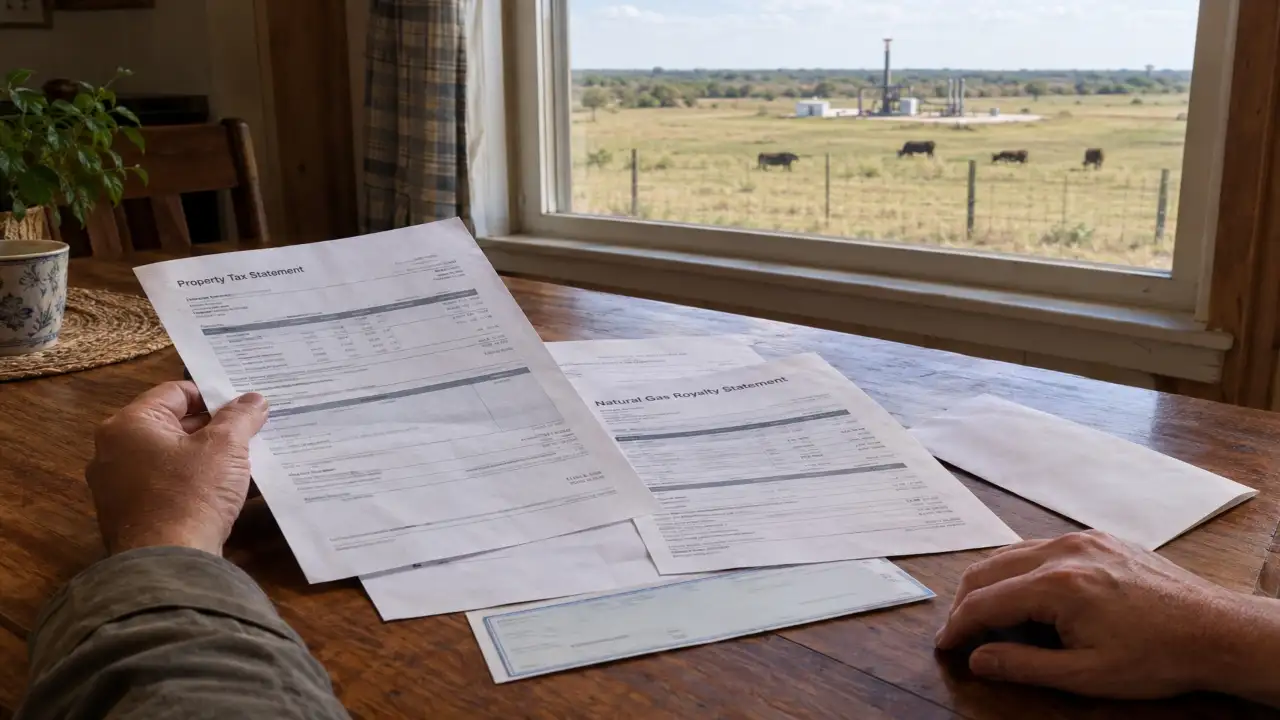
Because he did not want to surrender future income without fully understanding the consequences, he said he shredded some of the checks sent to him. AI-generated representative image showing property paperwork and royalty documents being reviewed at a Texas farmhouse, illustrating how an old land agreement revealed a new source of family income.
“My biggest monthly payment was $40,000,” he added, but he was careful not to structure his normal spending around revenue that may fluctuate. Lindsey said the amount of drilling made the property difficult to farm as it once had been. Lindsey said his family received offers to buy those rights almost every week, including mailings involving sums of millions of dollars.
The family’s experience came during the fast expansion of natural gas resources in north central Texas. Their territory was part of the larger area affected by the Barnett Shale, a geological formation that grew to be vital to the U.S. natural gas industry. The Railroad Commission of Texas’s overview of the Barnett Shale describes it as one of the country’s major onshore natural gas fields. The productive formation extends across thousands of square miles and includes Wise County, where the Lindsey property was located. The commercial emergence of shale gas has altered the economic value of numerous assets. The U.S. As extraction techniques improved, companies expanded drilling across the region. For landowners who had held on to their mineral rights, the move might bring revenue from minerals beneath property they’d owned for decades. The value depended on the presence of a productive formation under the property, on whether operators developed it, and on what percentage of production the lease gave to the owners. Those percentages were significant since a royalty owner’s payment is tied to the terms of the agreement and the volume and value of the gas generated. The money came with uncertainty The checks could be big, but Lindsey didn’t think of them as a sure wage. His wife still worked three days a week at a bank. The production companies regulated the amount taken from the wells. Changes in the price of natural gas affected the value of the production and thus the royalty payments. Prices decreased, and operators cut back on production. The family’s monthly income dropped. A productive well could generate substantial royalty income during one period and much less during another. The Railroad Commission of Texas guide to oil and gas royalties explains that royalty records can include production volumes, prices, taxes, deductions and the owner’s share of the proceeds. These details help explain why payments vary and why landowners need to understand the terms of their leases rather than judging income from a single check. The land itself had also changed. Mineral rights became a valuable asset that buyers sought to acquire. Credits – ChatGPT A windfall built on generations of ownership Lindsey advised other landowners to negotiate rather than accept the first offer they received. Lease terms can determine the royalty percentage, well locations, surface access and other conditions that affect the owner’s interests for years. His family’s experience also illustrates why landowners need to understand that ownership of the surface and ownership of the minerals beneath it can be separate. The family’s financial metamorphosis started not with a new investment or purchase, but with a company name on a tax statement. Taking that clue, Lindsey discovered an old drilling agreement for a resource that became valuable decades after the initial deal was made. The production, the price of gas and the terms of the leases are what made the land yield what it did. For Lindsey, the discovery showed that a property’s value can extend beyond what is visible at ground level. His family had farmed and raised cattle on the land for generations before gas production created a new source of income. The royalties also changed how the family could use the property and plan for the future. You use AI every day. Now get your AI Quotient. Take the AIQ test.
Companies acquired the technology and the experience to produce gas from deposits that had previously been difficult or uneconomic to develop at scale. He continued raising cattle for meat, but the family could no longer rely on the same combination of crop production and livestock that had sustained earlier generations. The value of mineral rights can change when new drilling technology makes previously inaccessible resources commercially viable.