
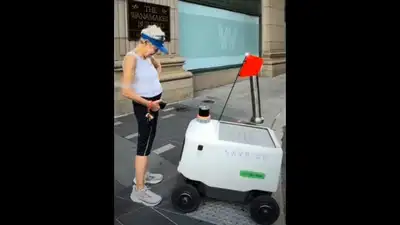
Retired professor has been arrested for blocking a delivery robot in Philadelphia.
A 78-year-old retired professor in Philadelphia has vowed to continue protesting delivery robots after she was arrested for repeatedly standing in their way, arguing that her actions were an exercise of free speech and a protest against technology taking over public spaces. October 14 was not the first time Marvin had placed herself in front of one of the robots. However, the October 14 incident ended with her arrest. Marvin said her protest had a limited impact on customers, with an office worker’s lunch potentially delayed by around 15 minutes at most.
Because she believed she was not obstructing another person, marvin said she never expected to be arrested. Uber Eats launched its autonomous delivery robot fleet in Philadelphia in March, making the city the fourth in which the company offered robot deliveries.
Carolyn Marvin, a retired communications professor at the University of Pennsylvania, said blocking autonomous delivery robots had become a habit since the small, wheeled machines began operating on Philadelphia’s streets and sidewalks. “I was under the impression that I had more rights than the robot did,” Marvin said, laughing. Marvin said she had been returning home after getting a flu shot when she encountered a delivery robot. Philadelphia police said they had responded to a report of “criminal mischief involving a delivery robot”. When officers arrived, they found a woman “who was refusing to allow a delivery robot to pass”, according to an email from the police department. I was impeding a machine,” she said. “I also think that I have a First Amendment right to protest the abuses of corporations in public space, in the same public space that the robots are occupying,” she said. Marvin said she had previously taken part in protests supporting civil rights and abortion rights, supporting Black Lives Matter and opposing the Gulf and Vietnam wars. She said blocking the machines had also led to conversations with passersby who wanted to know what she was doing. She added that she did not have unlimited time to spend blocking robots and would do so for 10 or 15 minutes when it was “convenient and possible”. In 2020, the state legislature passed a law classifying autonomous delivery robots, described in the legislation as “personal delivery devices”, as pedestrians rather than vehicles. The law requires vehicles to yield to delivery robots at crosswalks, just as they would to pedestrians, said John Mattiacci, a Philadelphia personal injury attorney. “Personal delivery devices must yield to other pedestrians and pedalcyclists in a pedestrian area,” Mattiacci said. “There’s a way in which we’ve surrendered the streets to cars long ago, and I don’t think we should surrender the sidewalks to machines,” she said. “Machines in general encroach on our lives,” she added. She said robots were a visible symbol of the wider spread of technology, including artificial intelligence and social media algorithms that influence the images and narratives people consume. Her protest, she said, helps make the issue visible and presents it in a way that might otherwise go unnoticed. This time, however, she said she would keep an eye out for the police.
She would stop them for a few minutes as they travelled along the sidewalk carrying food orders. She had a jar of enchilada sauce in one hand and chicken biryani takeout in the other when she stood in front of the machine, as she had done on previous occasions. The incident took place in a busy part of the city, and a larger-than-usual crowd gathered. Some people supported her, while others criticized her. Marvin suspects someone in the crowd eventually called the police. Officers handcuffed her, put her in a police vehicle and issued her a citation for disorderly conduct. Officers issued multiple commands asking her to move, but she refused to comply. “I wasn’t impeding any persons. She described her actions as a symbolic protest against the problems associated with delivery robots, including the displacement of low-income delivery workers, the physical risks the machines could pose to people using sidewalks and privacy concerns arising from their built-in cameras. She sees her campaign against delivery robots as an extension of the same impulse to make the government hear public concerns. Most were supportive or curious. A friend summed up her arrest by telling her: “Well, you got a disorderly conduct charge for impeding capitalism. Following her arrest, Marvin learnt more about the legal framework governing autonomous delivery devices in Pennsylvania. The legislation was largely opposed by Democrats, labour unions and accessibility advocates, who argued that allowing delivery robots could threaten jobs and put children and pedestrians at risk. Republicans supported the measure, describing it as an exciting technological development. However, the machines are also required to give way to people and cyclists in pedestrian areas. The machines have not been welcomed by everyone. Videos from Philadelphia and other places have shown people sitting on, kicking and vandalising delivery robots. Uber Eats did not respond to a request for comment. Marvin sees the growing presence of delivery robots as part of a wider trend in which technology and machines are increasingly occupying everyday spaces. “Public space is the most visible place where they’re encroaching on our lives, but they’re going right up the ladder, and lots of people are interested in making that happen. Asked whether she planned to resume blocking delivery robots after her arrest, Marvin had a brief answer: “Oh yeah. You use AI every day. Now get your AI Quotient. Take the AIQ test.