
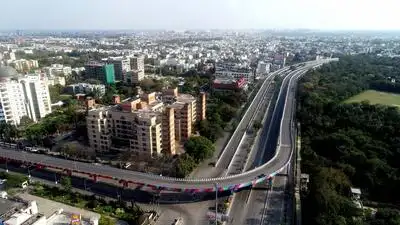
SCR has crossed its first major planning stage with the approval of its base map
For decades, Lucknow’s growth has followed the logic of a capital city. Jobs, education, healthcare, govt institutions, businesses and new housing have continued to concentrate in and around the city, drawing people from neighbouring districts. As the city expanded, roads and public transport grew with it, while new residential and commercial areas pushed its boundaries further out. WHAT WILL UP SCR CHANGE Instead of planning Lucknow as an isolated urban centre, the state govt is working towards a larger regional framework covering Lucknow, Sitapur, Hardoi, Unnao, Rae Bareli and Barabanki. The idea is to create a network of urban and economic centres around the capital, linked by roads, rail and public transport, while directing industrial, commercial and residential growth towards areas outside Lucknow.
The region covers around 27,826 sq km and had a population of about 2.29 crore according to the 2011 Census. The exercise is much bigger than adding new roads or identifying land for projects. It is an attempt to decide how a capital region spread across six districts should grow, where new economic activity should emerge and how people and goods should move between its centres. SIX DISTRICTS, ONE GROWTH REGION UP SCR brings together six districts with different levels of urbanisation, industrial activity and infrastructure. Lucknow is the dominant economic and administrative centre. Its concentration of govt offices, businesses, hospitals, educational institutions and service-sector jobs draws people from surrounding districts. The neighbouring districts have their own towns, industrial areas, agricultural economies and emerging urban centres but do not have the same concentration of employment and services. The concept is broadly based on the idea of the National Capital Region, where development is considered across administrative boundaries instead of being restricted to one city. For Uttar Pradesh , the challenge will be to create a regional network without allowing the smaller cities and towns to become mere extensions or commuter settlements of Lucknow. The proposed approach is to develop multiple centres of economic activity and connect them to one another. That could mean more industrial and commercial activity in neighbouring districts, better links between towns and new employment centres closer to where people live. The larger objective is to make it easier for residents to access jobs, education, healthcare and other services without having to travel to Lucknow for everything. A BIGGER CANVAS FOR LUCKNOW
The mapping exercise involved consultations with 22 departments and agencies, including development authorities, revenue, public works, railways, forest, irrigation and town and country planning authorities. Ground verification was carried out at 2,239 locations across the six districts. THE 2051 HORIZON SCR is being planned as a long-term project, with 2051 envisaged as a broad planning horizon. The region that exists today will look different over the next 25 years. Over the next 25 years, the capital region could see new industrial centres, logistics hubs, residential areas, transport corridors and commercial districts emerge beyond the city.
You Can Also Check: Gold Rate in Lucknow | Silver Rate in Lucknow | Bank Holidays in Lucknow | Public Holidays in Lucknow | Lucknow AQI | Weather in Lucknow | Petrol Price in Lucknow | Diesel Price in Lucknow | CNG Price in Lucknow | LPG Price in Lucknow Stay updated with the latest Lucknow news. SCR has now crossed its first major planning stage with the approval of its base map. The next step is a GIS-based regional master plan that will determine how the region develops over the coming decades, including the location of future infrastructure, industries, housing, commercial centres and transport corridors. The SCR could change the way the future growth of Lucknow itself is planned. Instead of the city continuing to absorb most new housing, businesses and institutions, some of that demand could be accommodated in planned centres outside the existing urban area. As regional hub, Lucknow will remain the administrative and economic centre but its relationship with neighbouring districts will change. A regional approach could allow Lucknow to function as the core of a larger network rather than as a city carrying most of the region’s economic load. Unplanned development along highways and the city’s outskirts can create pressure on roads, drainage, water supply and other services. Planning growth at a regional level offers an opportunity to decide in advance where major development should take place and what infrastructure should support it. CONNECTIVITY TO DRIVE GROWTH Transport will be one of the most important pillars of SCR. Proposed projects include the ‘Rajdhani Rajya Mala’ (State Capital Mala regional road network), elevated peripheral roads, road-upgradation works, an orbital rail corridor and expansion of metro network. The aim is to create a network rather than simply improve roads leading into Lucknow. For the region to function as an integrated economic zone, movement between its different centres will be as important as movement towards Lucknow. A worker living in Barabanki should eventually have more options for finding employment within the wider region. Similarly, a business in Sitapur or Unnao should be able to move goods efficiently to markets, logistics hubs and transport corridors. Public transport will also determine whether the regional plan remains accessible to people who cannot rely on private vehicles. The long-term transport network will have to connect major cities, smaller towns, industrial areas, commercial centres and residential developments rather than operate as separate projects. NEW CENTRES FOR JOBS & BUSINESS Economic development is at the heart of the SCR concept. Lucknow has a higher concentration of businesses and service-sector employment than its neighbouring districts. The proposed regional framework seeks to create new centres where industries, logistics, food processing and other businesses can grow industrial areas, logistics parks and food parks are among the proposed interventions. The Lucknow-Kanpur Expressway is also expected to influence future development. Areas along major transport corridors can attract manufacturing, warehousing, food processing and other businesses if land use and supporting infrastructure are planned together. The challenge will be to prevent ribbon development and scattered construction along these corridors. The regional master plan can identify areas suitable for industry, housing, commerce and other uses, allowing infrastructure to be provided in a planned manner that could also make it easier to attract investment outside Lucknow. FROM COMMUTING TO LOCAL EMPLOYMENT One of the biggest potential changes under SCR could be in the way people travel for work. Currently, Lucknow acts as the region’s main employment magnet. People from neighbouring districts travel to the city for govt work, business, education, healthcare and jobs. Creating employment centres outside Lucknow could gradually reduce that dependence. The aim would not be to stop movement between districts. Instead, better connectivity would give residents more choices. Someone living in Hardoi could find employment in a nearby industrial or commercial centre rather than travelling to the capital every day. Businesses in smaller cities could connect more easily to larger markets. This could reduce pressure on Lucknow’s roads and housing while strengthening the economies of neighbouring districts. RURAL-URBAN CONNECT SCR will also have to account for the large rural areas within its boundaries. The region is not made up only of large towns and cities. Villages and smaller settlements form a substantial part of the six districts. If development is concentrated only around major urban centres, the benefits of SCR could remain limited. Better roads and public transport could improve access to schools, hospitals, markets and employment. New economic centres could provide jobs without forcing people to relocate to Lucknow. FOCUS ON CIVIC FACILITIES Water supply, sewage, housing, healthcare, education and local markets would need to expand alongside employment. Otherwise, new industrial or commercial centres could simply create pressure on existing towns. The regional master plan will have to connect economic development with social infrastructure. The importance of the base map lies in the information it provides for this next stage. Satellite imagery and map-based information were checked against actual conditions on the ground. The exercise gives planners a more detailed picture of existing settlements, infrastructure, land use and other physical features. That information will form the basis for the GIS-based regional master plan. For a region of this size, accurate mapping is critical. A new highway, industrial area or housing development can alter the pattern of growth around it for decades. Planning those changes together could prevent the kind of scattered development that later requires expensive infrastructure upgrades. SEVEN AREAS THAT WILL SHAPE SCR The broader planning framework focuses on seven areas: economic development, social welfare, health, education, housing, transportation and regional preservation. Together, they indicate that the SCR is being conceived as more than an infrastructure project. Economic growth will need housing for workers. New housing will require water, sewage, schools and healthcare. Industrial areas will need roads and logistics facilities. Transport corridors will influence where businesses choose to locate. ADDRESSING ENVIRONMENTAL CONCERNS The expansion of cities and industrial activity can put pressure on agricultural land, water bodies, forests and other natural areas. Regional planning provides an opportunity to identify areas where development needs to be regulated and where environmental preservation should take priority. That makes the decisions taken during the preparation of the regional master plan significant. Population will increase, existing towns will expand and new economic corridors could emerge. The challenge is to anticipate that growth rather than respond to it after development has already taken place. A new industrial corridor can generate demand for housing. A railway line can shift the location of markets. A major road can turn a rural stretch into a commercial zone. If such changes are planned together, infrastructure can precede development instead of following it. WHAT SCR COULD MEAN FOR LUCKNOW The most visible outcome of SCR may eventually be a change in the way Lucknow’s growth is measured. For years, the city’s expansion has been assessed through new roads, housing projects, commercial areas and population growth within its boundaries. SCR introduces different measures: how effectively Lucknow is connected to and supported by the cities and towns around it. A successful regional model would mean that economic opportunities are not concentrated in one city. It would mean more employment centres, better connectivity, improved services and planned urban growth across the six districts. For Lucknow, this could mean less pressure on land and infrastructure. For neighbouring districts, it could mean access to new investment and employment. For residents, the change could be more practical: fewer journeys to the capital for jobs and essential services. FROM CAPITAL CITY TO CAPITAL REGION The idea behind SCR is not to make Lucknow bigger by extending its physical limits but to make the wider region around it connected and economically active. That would require the capital city to remain the region’s core while allowing surrounding districts to develop their own economic and urban identities. The regional master plan will be central to that effort, it will have to decide where growth should happen, which areas need protection, where new infrastructure should be built and how different parts of the region should connect. The bigger question is whether these developments will grow as separate projects or as parts of one regional plan. For Lucknow, the next growth story may no longer be confined to the city itself. It could increasingly be written across six districts, with the capital at the centre of a much larger regional economy. Download the TOI App.