
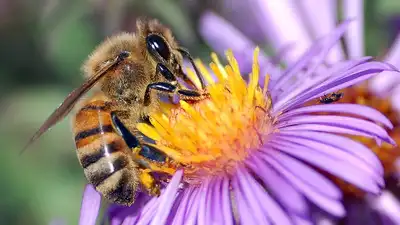
Honey Bee
Scientists kept each site within 300 meters of an established honey bee colony. Honey bees are proving to be formidable competitors for food in the UK and scientists have discovered that they frequently use aggression to drive other pollinators away from flowers. New research has documented how honey bees chase, displace and intimidate rival insects, providing the first detailed evidence of how extensively they interfere with other species’ access to food. The study was conducted by researchers at Anglia Ruskin University (ARU) and published in Ecological Entomology. It followed pollinator activity over two years at five locations in and around Cambridge, England.
The ivy bee, a solitary species not native to Britain that was first documented in the country in 2001, was the only pollinator observed actively challenging honey bees. Aggressive behaviour initiated by species other than honey bees was uncommon. However, one insect stood out as an exception. Ivy bees were different from most other insects in that they sometimes defended their feeding sites by chasing or displacing honey bees and winning the competition for access to flowers.
Climate change may make competition worse
Over 93 hours of observation, the scientists documented encounters in which one insect interrupted another’s feeding or prevented it from reaching a flower. Doubling the density of honey bees on bramble flowers led to a 14% reduction in bumblebee abundance. Other pollinators actively avoided honey bees in 28% of observed interactions on bramble and 36% of those on ivy. The scientists found that in at least 20% of the encounters honey bees won on either plant, they physically pushed aside or chased away competing insects. The number of registered beekeepers increased from 19,000 in 2010 to 47,000 last year, reflecting growing numbers of managed honey bee colonies.
The honey bees frequently initiated aggressive encounters, driving other insects away to secure feeding opportunities, according to scientists. The scientists observed insects visiting bramble (Rubus fruticosus) and ivy (Hedera helix) – two flowering plants that provide important supplies of nectar and pollen. Both attract large numbers of insects during their flowering periods, hence, making them useful places to investigate competition for food. To examine how different pollinators interact, the team divided flower visitors into five groups: honey bees, bumble bees, solitary bees, hoverflies, and an ‘other’ category containing butterflies, beetles and wasps. Each interaction was classified based on its outcome. A ‘win’ occurred when one insect accessed a flower at the expense of another, which suffered a ‘loss’ of feeding opportunities. That ‘share’ meant both insects could access the flower without coming into conflict. The results showed a clear pattern. Places with more honey bees tended to have fewer other pollinators and more competition for flowers. Honey bees also emerged victorious in a larger proportion of their encounters with other insects. On ivy, higher honey bee numbers were linked to reduced numbers of solitary bees and hoverflies. The findings are part of a broader research effort to understand competition among pollinators and identify ways to reduce its ecological effects. The results also come as beekeeping continues to expand across the UK. Researchers warn that rising temperatures could add to the pressure on wild pollinators. Their observations showed that competitive encounters became more frequent during warmer conditions. You use AI every day. Now get your AI Quotient. Take the AIQ test.