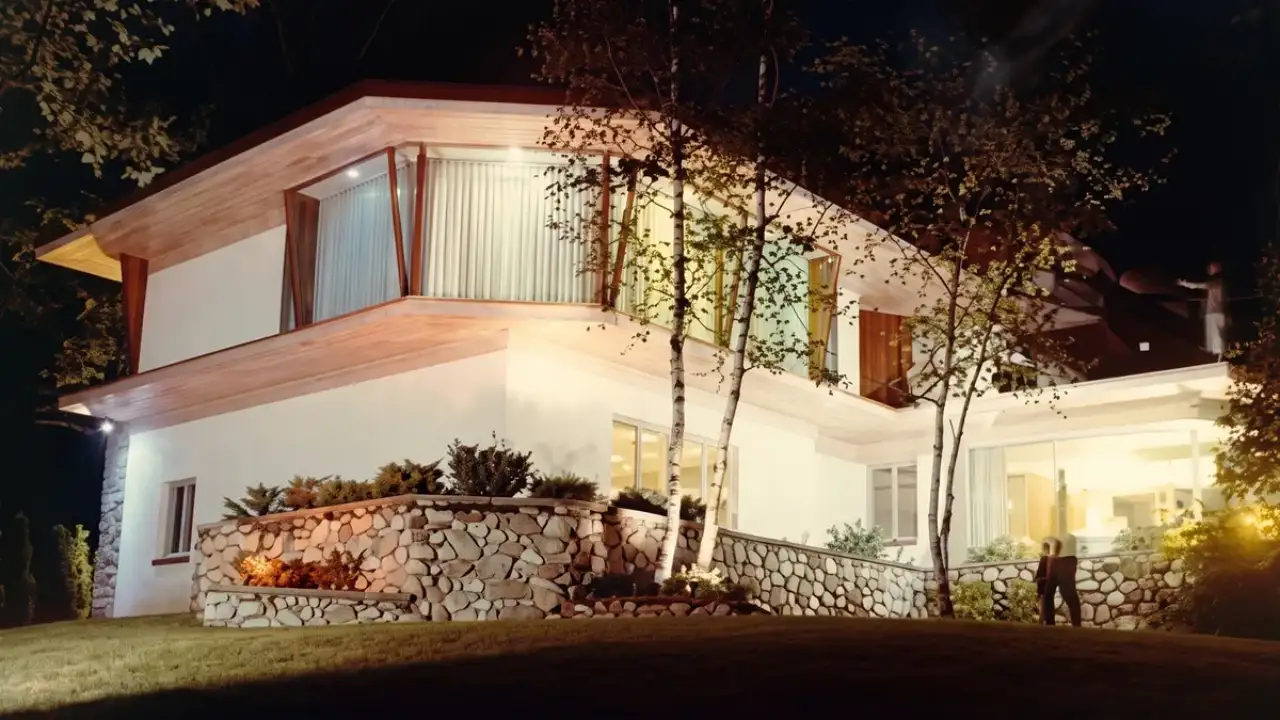
A 1957 photo of Les and Mary with their collie (Image credit: Ben Martin/Getty Images via Guitar Player)
The New Jersey home where legendary guitarist and inventor Les Paul lived, worked and helped reshape modern music recording has been demolished, just weeks after the seven-acre Mahwah property was sold for $990,000. Because the house was not simply a former celebrity residence; it included the spaces where Paul experimented with sound, developed recording techniques and worked on ideas that would influence generations of musicians and producers, the loss drew particular attention. For Gene Paul, therefore, the demolition was about more than the disappearance of an old house.
In his Facebook post, he described the property as his father’s workshop and laboratory and said its destruction was deeply upsetting. In his Facebook post, Gene Paul said his family was given no advance warning of the demolition and was not given an opportunity to enter the house before it was destroyed. A statement from the Les Paul Legacy Group, cited by Guitar Player, said that people close to Paul made a last-minute effort to save historically significant material, including handwritten research notes and Paul’s workbenches. Some of those items were found in rooms that had suffered water damage and mold after years of alleged neglect by the foundation, according to the group. The couple recorded songs and their television show, Les Paul & Mary Ford at Home, at the Mahwah house, according to Guitar Player. The foundation’s executive director, Michael Braunstein, defended its preservation efforts, while comments describing the historic property as essentially “four walls” drew criticism from members of the music community, guitar historians and Paul’s family, according to Guitar Player.
Les Paul’s son, Gene Paul, spoke about the demolition in a Facebook post , saying the family received no advance warning that the property was going to be demolished. He described the loss of the home as deeply painful and questioned how the property had been handled. He and Mary Ford also recorded songs and their television show at the house. He questioned how the property had been handled and why his family had not been given a meaningful opportunity to be involved. He described seeing his father’s former home gutted and questioned why the family had not been consulted about its fate. The loss also raised concerns about what remained inside. Les Paul was far more than a celebrated guitarist. His experiments with sound and recording helped lay the foundations for techniques that later became central to modern music production. At the Mahwah property, his work included pioneering experiments with multitrack recording and electric-guitar technology. The site also became a destination for prominent musicians; famous guitarists visited Paul there to discuss music and technology. That history is why Gene Paul and others have objected to describing the property as simply an old building. Its significance, they argue, lay not only in its association with a famous musician but also in the work that took place within it. The home was also closely connected to Les Paul and Mary Ford’s musical and television careers. The demolition has also sparked a disagreement involving the Les Paul Foundation. At the centre of the dispute is a larger question: when does a private home become an important part of cultural history?