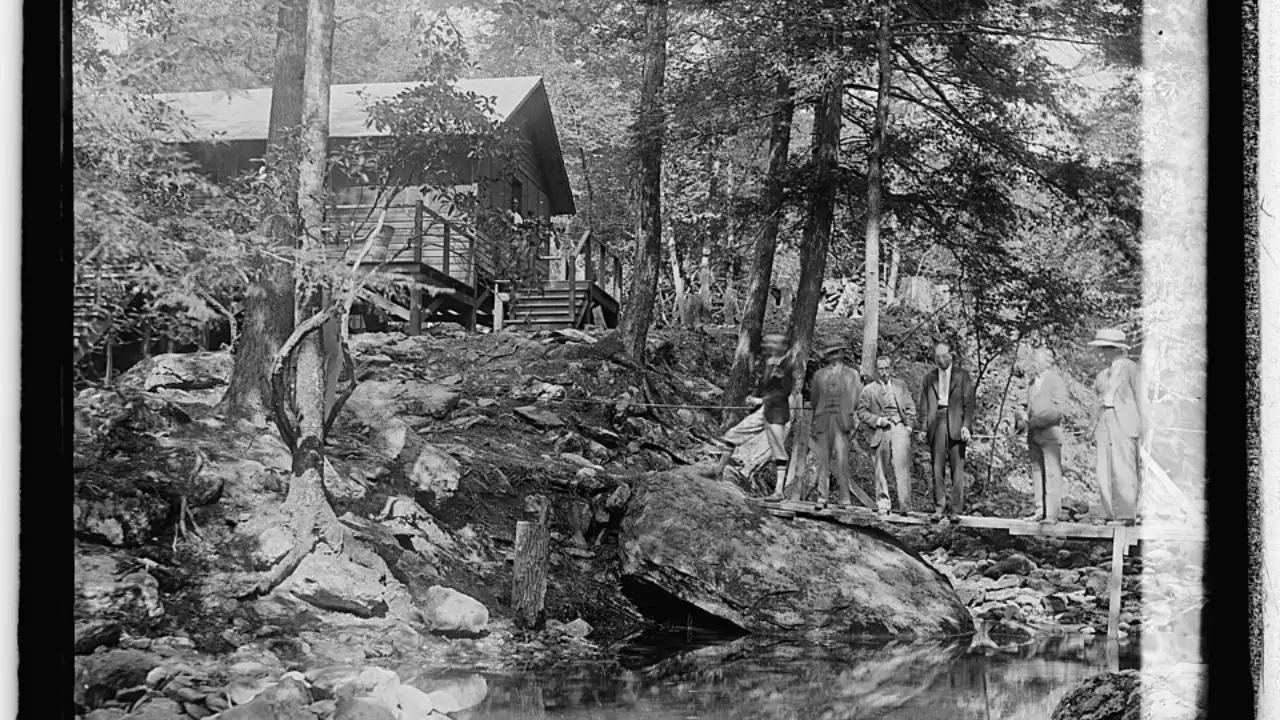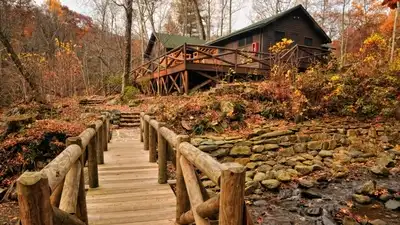
Rapidan Camp at Shenandoah National Park. Image credits: NPS
In 1933, as Herbert Hoover left the White House after losing re-election, he donated Rapidan Camp, his secluded Virginia mountain retreat, to the federal government for incorporation into the future Shenandoah National Park. Today, the Rapidan Camp remains within the park, while the National Park Service describes Shenandoah as less than 90 miles southwest of Washington, DC. President Hoover and his wife, Lou Henry Hoover, established Rapidan Camp in 1929, shortly after Herbert Hoover took office. The property covered about 164 acres and was privately owned by the Hoovers during his time as the country’s president. Hoover lost his 1932 re-election campaign to Franklin D. Roosevelt, whose inauguration took place in March 1933. The NPS timeline records the donation in 1933, thus allowing the camp to become a part of the federal park landscape that was being assembled in Virginia. Congress had authorised the park in 1926, but Virginia still had to acquire and transfer the necessary land before the federal government could formally establish it. The park was eventually established on 26 December 1935, and Roosevelt formally dedicated the park on 3 July 1936. Further rehabilitation took place between 1960 and 1963, and decades later the NPS carried out a restoration focused on historical accuracy. After decades of exposure had led to the dismantling of the site’s temporary structures, in 2004, the agency completed the restoration of the grounds and the three surviving cabins associated with Hoover’s retreat: the Brown House, Prime Minister’s Cabin and the Creel Cabin.
Therefore, the preservation of Rapidan Camp offers a link to a pivotal era in American history.
Hoover conducted official business there and held meetings with visitors, thus creating a working presidential camp far removed from the formal surroundings of Washington, according to the National Park Service. The NPS describes the camp as Hoover’s “summer White House,” reflecting its role as a presidential retreat during his administration. The former presidential retreat preserves the unusual setting where Hoover combined fishing and recreation with his federal work during some of the most difficult years of the Great Depression. The camp stood at the headwaters of the Rapidan River in the Blue Ridge Mountains and included several other rustic buildings surrounded by forest. the site was not simply a holiday retreat While fishing was reportedly one of the president’s favourite pastimes. Furthermore, the location held significance as it was situated within the landscape being considered for the creation of Shenandoah National Park . The president supported the park project and intended to make the future park accessible. The camp consequently became a place where presidential recreation and government business overlapped. Hoover could fish in the surrounding streams and escape the capital’s political pressure while still receiving visitors and dealing with matters of state. As the former president prepared to leave office, he offered Rapidan Camp to the federal government for use as a part of the proposed Shenandoah National Park. However, Shenandoah was not yet a national park when Hoover made the gift. The agency’s work aimed to preserve the appearance and character of the camp during the Hoover years instead of leaving the buildings to deteriorate. The historic cabins that would have otherwise deteriorated now stand as an educational resource in Shenandoah National Park, thus allowing modern visitors to explore the unique environment where a president found solace during the heights of the Great Depression.