
Image: AI
In ancient China, people believed a celestial dragon was devouring the sun, and reports note that Chinese eclipse records stretch back more than 4,000 years, with one text simply stating “the sun has been eaten.
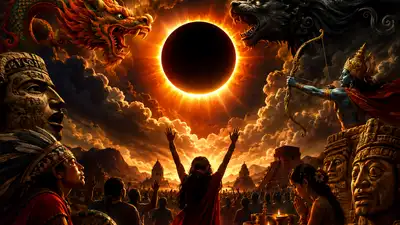
That myth is why, even now, many households across India avoid eating, cooking, or stepping outdoors during a solar eclipse, and why pregnant women are often told to stay in and avoid sharp objects. Certain Navajo traditions call for sitting quietly indoors and letting the eclipse pass undisturbed, treating it as a moment to respect the relationship between the earth, moon and sun rather than fight it, according to writer Dan Szczesny. They covered windows, stopped cooking, stayed indoors, and waited it out. The oldest and most widespread explanation is astonishingly consistent no matter where you look. So people did the obvious thing. They banged drums and pots and screamed at the sky to scare the creature off, and since the sun always did come back, the tradition just kept getting reinforced. Vietnam blamed a giant frog for the same, Norse mythology blamed wolves, and Korean folklore pointed to mythical dogs trying to steal the sun outright. Different animals, same panic, same fix, make noise, get the sun back. In Hindu mythology, the story is darker and more specific. The demon Rahu drank the gods’ nectar of immortality and was beheaded for it, but his severed head kept living, and it chased the sun and moon across the sky forever, swallowing them whenever it catches up. It’s not really about believing a demon is out there. It’s a ritual pause, a pocket of stillness passed down long after the original explanation stopped being literal for most people. The Inca took a completely different emotional route. To them, the sun god Inti was generally kind, so an eclipse meant he was furious about something. Britannica describes how Incan spiritual leaders would try to figure out what had angered him, and the emperor himself would withdraw from public duties and fast until the crisis passed. That’s a pretty telling detail, even a ruler considered semi-divine felt the need to step back and go quiet when the sky turned dark at the wrong time. Not every culture reached for noise. Some went the opposite way entirely. What’s striking is that fear and reverence often produced the exact opposite behavior, some cultures got loud, others went completely silent, but almost nobody just carried on normally. The sun disappearing mid-morning broke something ancient in the human brain long before anyone understood orbital mechanics, and the rituals we’re left with are basically old coping mechanisms that outlived the fear that built them. Looking for trusted parenting advice? Follow TOI Parenting Circle on Instagram for expert guidance, relatable stories, and practical tips delivered every day.
Today’s total solar eclipse will draw millions of eyes upward across Iceland, Spain and beyond, but for most of human history, people didn’t look up at all. And that instinct to treat an eclipse as something you survive rather than something you watch runs through nearly every culture on Earth, in ways that still shape rituals today.