
Image: AI
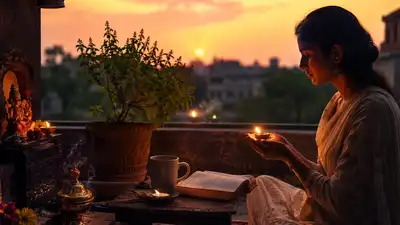
Compare that to how most of us actually end our evenings now, scrolling with one hand and eating with the other, and you start to see what’s been lost. Most of us treat evenings as dead time. The gap between work ending and sleep starting, filled with whatever’s easiest, usually a phone screen and some background noise from the TV. But every Indian household used to run on a completely different evening script, one that had almost nothing to do with productivity or entertainment and everything to do with just closing the day properly. And a lot of that script has quietly disappeared over the last couple of generations. This sounds almost too simple to count as a ritual, but that’s kind of the point. Many households used to close the evening with a cup of tulsi or herbal tea, taken slowly, without a phone in hand and without multitasking through it. The habit wasn’t really about the tea itself. It was about giving yourself five uninterrupted minutes where nothing was being consumed except the drink and the silence around it. Almost every Indian home used to have a tulsi plant somewhere, in the courtyard if there was one, or in a pot by the window if there wasn’t. And the evening watering wasn’t a two second chore squeezed between other things. Women would water it, touch the leaves, sometimes whisper something under their breath, and light a small lamp beside it before moving on with the night. There’s actual substance behind this too. Tulsi has documented anti-inflammatory and antimicrobial properties, and in Ayurveda it’s long been used for everything from colds to anxiety. So this wasn’t just a symbolic gesture toward a sacred plant. It was also, quietly, a small daily dose of something genuinely good for you, wrapped inside a moment of stillness. Reading a short passage from the Gita, or honestly any text with some weight to it, used to be a normal way to close the day in a lot of homes. Not for hours, just a page or two, sometimes read aloud to whoever else was around. It’s the ritual equivalent of a bedtime story for adults, and it did something screens can’t. It gave the mind one slow, linear thing to hold onto before sleep, instead of the fragmented, algorithm-fed scrolling most of us do now until our eyes finally give out.
Actually finishing the day, instead of letting it bleed into the next one
This last one is less a specific act and more the whole spirit behind the other four. The idea of sandhya was never about performance. It was about a clean crossing from one state to another, treating the evening as an actual boundary rather than just a blurry extension of work. Most of us don’t have that boundary anymore. Laptops stay open at the dinner table, work messages ping well past nine, and sleep starts feeling like an interruption rather than a natural stop.