
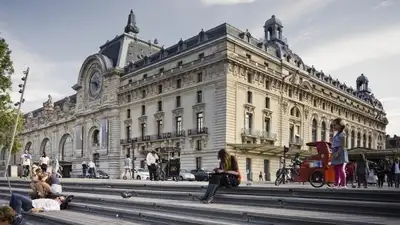
A Paris railway station was almost demolished, then became one of the world’s greatest art museums.
Imagine arriving in Paris in 1900 and stepping off a train into a vast hall of steel, glass, stone, and electric light! Go back to 1900 and picture the scene: the World’s Fair is in full swing, and Paris wants a railway station that’s not just functional but breathtaking. When it opened on Bastille Day in 1900, the Gare d’Orsay was more than just a train station; it was a modernist trophy. Trains grew and stretched, technology changed, and by 1939, the station’s platforms were simply too short for the new generation of powerhouse locomotives.
Because something gets old, it doesn’t stop being valuable, this soaring glass-and-stone marvel on the Seine doesn’t just house some of the greatest Impressionist works in the world; it’s a survivor, plucked from the jaws of demolition not so long ago, and proof that just. The Compagnie des Chemins de fer d’Orléans wants to build a new station in Paris’s poshest quarter and get people from the southwest of France into the heart of the city. Architect Victor Laloux wins the job and, with a bit of cleverness, hides all the mechanics and tracks behind opulent stonework. Inside, it’s a cathedral of steel and light, a technical marvel with electrified tracks, elevators and baggage lifts, and platforms lurking out of sight underground. Per the official website, that pride lasted — well, not quite as long as you’d hope. The grand hall suddenly became a white elephant: too beautiful to use for freight, too awkward for regular trains, too precious (and too enormous) to simply abandon.
Arriving at the Musée d’Orsay today, you’d probably never guess its beginnings were so ordinary, or so almost tragic.
In 1973, the station squeaked onto the supplementary list of historic monuments. In 1986, the Musée d’Orsay opened—right on the bones of the old railroad. For decades, the building played host to a rotating cast of temporary tenants. During World War II, it became a depot for prisoners’ parcels, then a staging ground as those prisoners returned. Later, it doubled as a theatre company’s home, an auction house, and even a movie set (Orson Welles filmed bits of ‘The Trial’ here). But by the 1970s, bulldozers loomed. Paris didn’t always look kindly on its own history then, and there was real talk of flattening the Gare d’Orsay to make room for another hotel. But public sentiment and a growing love for nineteenth-century architecture planted its roots. Five years later, it graduated to full historic status, and just in time: the idea of creating a museum caught fire. Paris suddenly needed a home for its booming Impressionist collection, as the Louvre was already bursting at the seams, and the grand old station seemed perfect, if it could be saved. Now, the refurbishment was anything but simple. Turning a huge, flood-lit concourse meant for locomotives into exhibition space took both vision and nerve. Architects Colboc, Bardon, and Philippon (plus Italian designer Gae Aulenti, who made the insides work) kept Laloux’s industrial grandeur but softened it for art, carving elegant galleries into the station’s frame and letting light play on stone and brushstroke alike. They didn’t erase the station; they transformed it. The old clocks look out over the river, visitors drift through spaces once packed with steam and bustle, and the vast glass ceiling throws natural light over gallery walls. It’s a stunning lesson in how to make history work in the present, not by keeping everything frozen, but by letting an old building tell a fresh story.
Today, Musée d’Orsay isn’t just a backdrop for paintings by Monet or Van Gogh; it’s a star in its own right.
Because it was saved at the last moment, the Musée d’Orsay is one of the world’s great museums precisely.
The station nearly disappeared because it was out of date, but that very “uselessness” became its advantage. The story does read a bit strange, doesn’t it? Where travelers hurried toward their next stop, visitors now pause, stare, and lose themselves in paint. Its journey from railway hub to cultural landmark shows how the best way to honor the past isn’t to conserve it in amber, but to let it evolve and find new meaning. In the end, the building that once welcomed millions in transit now invites millions to linger, and that’s a different kind of magic. Looking for trusted parenting advice? Follow TOI Parenting Circle on Instagram for expert guidance, relatable stories, and practical tips delivered every day.
Today, the grandeur Laloux hid for fear of offending Parisian taste is on full display, framing the art it now protects.