
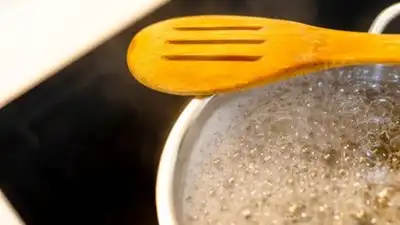
It sounds like exactly the kind of thing that shouldn’t work, and yet, according to actual kitchen science research, there’s genuine physics behind it. Anyone who’s ever walked away from a pot of pasta water for thirty seconds too long knows the particular panic of hearing that telltale hiss and sizzle as foam races over the rim and onto a hot stove. A trick that’s been doing the rounds on social media for years claims to fix this with almost nothing, just balance a wooden spoon across the top of the pot, and the boil-over supposedly stops in its tracks. There’s also an important catch worth knowing before you rely on it completely.
Here’s a detail that surprises most people: a pot of pure, plain water boiling rapidly generally won’t rise up and spill over the sides, no matter how vigorously it bubbles. The real culprits are the starches and proteins in whatever you’re actually cooking, pasta, rice, porridge, or milk are the classic offenders. When these molecules come into contact with boiling water, their structure changes in a way that stabilises the bubbles forming at the surface, letting them build into a thick, resilient foam that climbs higher and higher until it eventually spills over the edge, something plain water’s simpler, weaker bubbles rarely manage to do. A few small details make a real difference in how well this actually performs. A completely dry wooden spoon works better than one that’s already damp, since dryness is what gives the wood its rough, bubble-popping texture in the first place. A flatter, wider spoon or spatula tends to cover more of the pot’s surface than a narrow one, intercepting more rising foam at once. It’s also worth remembering this works specifically as a delaying tactic rather than a total fix, genuinely useful for buying time while you turn down the heat or grab a bigger pot, rather than something to rely on completely unsupervised. The cooling and bubble-disrupting effect is genuine and has held up under actual scientific scrutiny. What it isn’t is a permanent, walk-away solution, its effectiveness fades as the spoon warms up and gets wet, which makes it best used as one part of a broader approach rather than the only thing standing between you and a messy stovetop.
Pingback: The tiny kitchen trick that makes chopping safer — Put a towel under your cutting board