
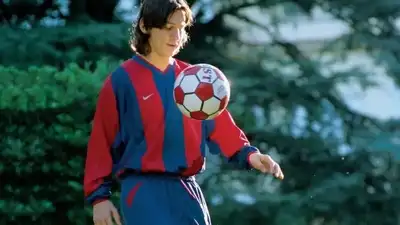
Lionel Messi was signed at 13 on a napkin; at 29, he almost quit football, but then came back to lift FIFA World Cup for Argentina.
The boy from Rosario who left Argentina at 13 to pursue a dream in Barcelona grew into one of the most decorated players the game has ever produced. On August 31, 2026, Messi finally stopped the clock on that dream that became an illustrious journey. Per Reuters, the 39-year-old announced his retirement from international football, ending a 21-year senior career with Argentina. His final appearance was in the 2026 FIFA World Cup final, where Argentina lost 1-0 to Spain after extra time. 28 Jul 2026 | 16:22 As it stands now, Messi leaves the national team with 125 goals in 207 appearances, two Copa América titles, and the World Cup trophy he had spent much of his career chasing. He’ll continue to play club football for Inter Miami, with his contract running through 2028. By 13, Messi’s family rolled the dice, heading off to Barcelona with everything riding on a club’s promise to pay for his expensive growth-hormone treatments. After three straight heartbreaks — the 2014 World Cup loss to Germany and two Copa América championships gutted away on penalties — Messi, 29, simply broke. People compared him to Maradona, the man who’d won in ‘86 and become a myth. The 2021 Copa América arrived, and Messi finally hoisted a major trophy for Argentina, beating Brazil in their own backyard. Argentina’s 2022 World Cup campaign started poorly, with a loss to Saudi Arabia. Messi and Argentina conquered another Copa América in 2024, proving it hadn’t been a one-off. And finally, there was 2026: Messi at 39, still guiding his nation to one more World Cup final. Numbers aside (207 appearances, 125 goals, two Copas, a World Cup), it was the spirit in between losses that actually built his legend. When Messi finally walked away from the national team at 39, nobody dared call him a prodigy who didn’t do enough or couldn’t achieve enough. He was the captain, the one who ended a 36-year drought, the champion who refused to quit.
His international retirement is therefore not simply the end of a career. Because the climb from La Masia to Barcelona’s first team was fast, but everything beyond that went from dream to legend, and maybe it had to be,. Because he craved redemption, but because he couldn’t stop himself, the noise never softened, but Messi returned; not. Because the pain was too much, he left.
The question hung heavy: “What has he won for us? Six weeks later, Messi announced he was done with Argentina. He lost again.
“I tried so hard to be champion with Argentina, and it didn’t happen,” he once said, sounding raw and exhausted. For more than two decades, Lionel Messi was not merely the name of just another footballer; he was a moving argument for persistence with discipline. However, it’s important to note that this is not retirement from football altogether. It is the closing chapter of one of football’s most extraordinary stories, one that travelled from a teenage contract scribbled on a napkin to the World Cup podium. Now, nobody ever really believed the Lionel Messi story would follow a straight line. People love to talk about destiny, as if Messi were born with a golden ticket, but life kept smacking him around, especially when he wore the Argentina shirt. What he built wasn’t handed to him, and that’s probably why his journey means so much to so many. It started innocently enough in Rosario: just another gifted little kid, way smaller than the rest, trying to dribble his way through local defenders. The paperwork? A napkin. The faith? Well, that was massive. Whenever he came home to play for the Argentine national team, the reception was colder. You could feel the weight each time another final slipped away. He walked away, literally announcing he’d had enough. For a moment, nobody could imagine football in blue and white without him. But leaving wasn’t in his DNA. For years, he kept grinding. Messi was burdened with that shadow every time he stumbled. Just when everyone’s patience was paper-thin, something snapped the curse. Relief washed over him, over Argentina, over everyone who’d watched him suffer. Now, he wasn’t the superstar who stumbled at the final hurdle. He was a champion. The story hit fever pitch in Qatar. Instead of collapsing, the team, and Messi in particular, just got stubborn. They clawed their way back, fighting through giants, until France waited for them in a final that barely felt real. Messi scored twice, including one in extra time. Penalties followed. Argentina held their nerve. Messi kissed the World Cup trophy; that photo became instantly iconic. Suddenly, the Maradona comparison faded. This was Messi’s story now, and it was impossible to look away. Even then, he wasn’t done. Along the way, he just kept breaking barriers, shattering ideas of what an athlete could do over two decades. This time, the fairytale ran out: Spain beat them in extra time. Of course, the records are staggering, and they’ll echo long after he’s retired. But what stays with people is the stubborn persistence. He came back. He kept coming. Eventually, it paid off. What reads like a fairy tale in his story is that Barcelona turned a scrawny kid with outsized dreams into a phenomenon. Argentina gave him his greatest trials and his greatest rewards, and maybe taught him the hardest lessons. The kid from Rosario? He made it big, and in doing so, he finished the journey with the whole world watching. Looking for trusted parenting advice? Follow TOI Parenting Circle on Instagram for expert guidance, relatable stories, and practical tips delivered every day.
Over the next 17 years, he tore up the record books: 10 La Liga titles, four Champions League trophies, and 91 goals in a single year, which is a stat that still looks like a typo. It wasn’t just that he was playing for the Spanish club; Messi became synonymous with Barcelona. Eight Ballon d’Or awards. In Spain, he basked in love and respect; the Camp Nou almost worshipped him. But for years, none of that landed back home in Argentina the way he needed it to.