Savitribai Phule established an extensive educational network
You Can Also Check: Gold Rate in Pune | Silver Rate in Pune | Bank Holidays in Pune | Public Holidays in Pune | Petrol Price in Pune | Diesel Price in Pune | CNG Price in Pune | LPG Price in Pune Stay updated with the latest Pune news. Bhide Wada may be the classroom most associated with Savitribai Phule. But the less familiar story is what happened when she began building beyond it. Download the TOI App.
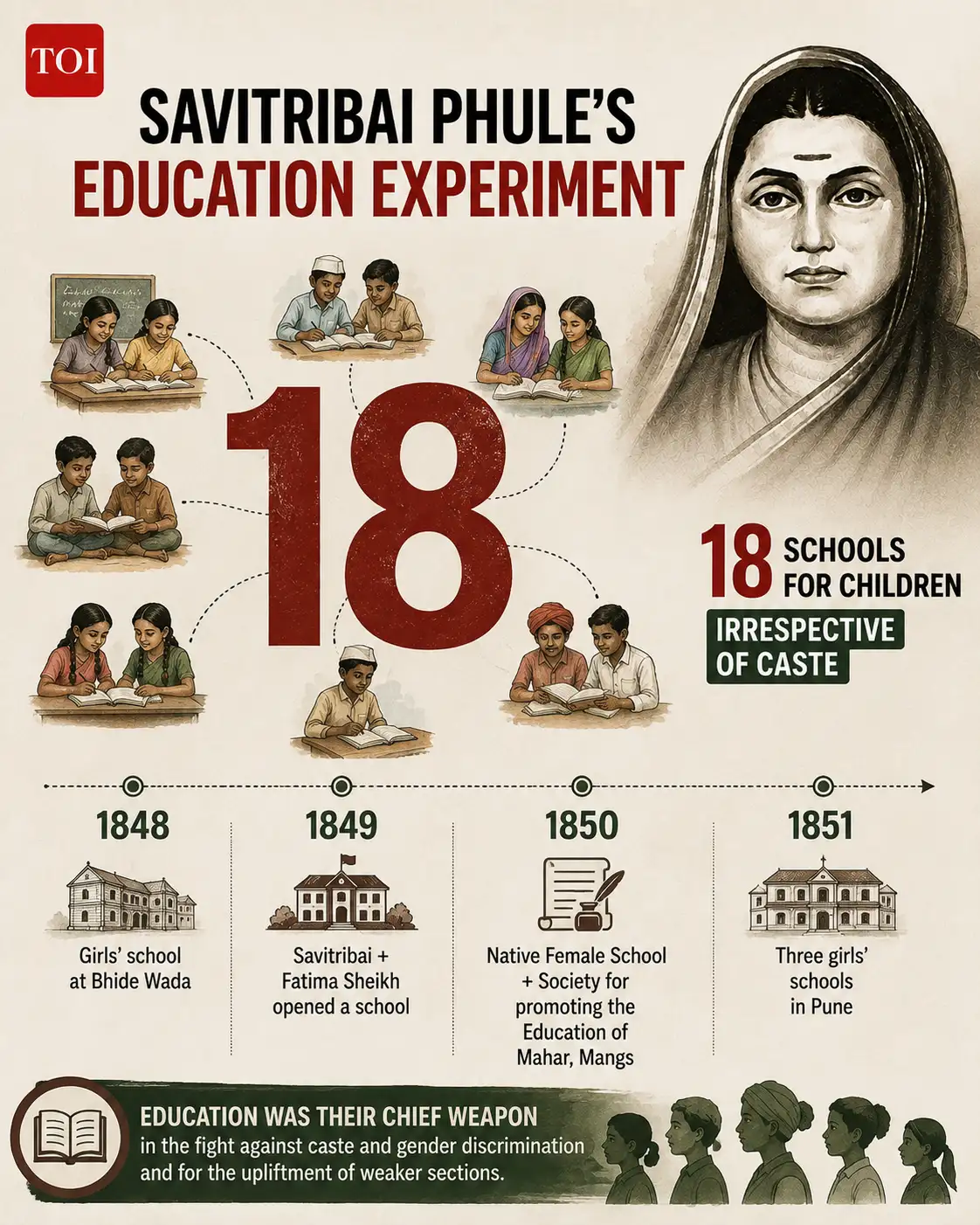
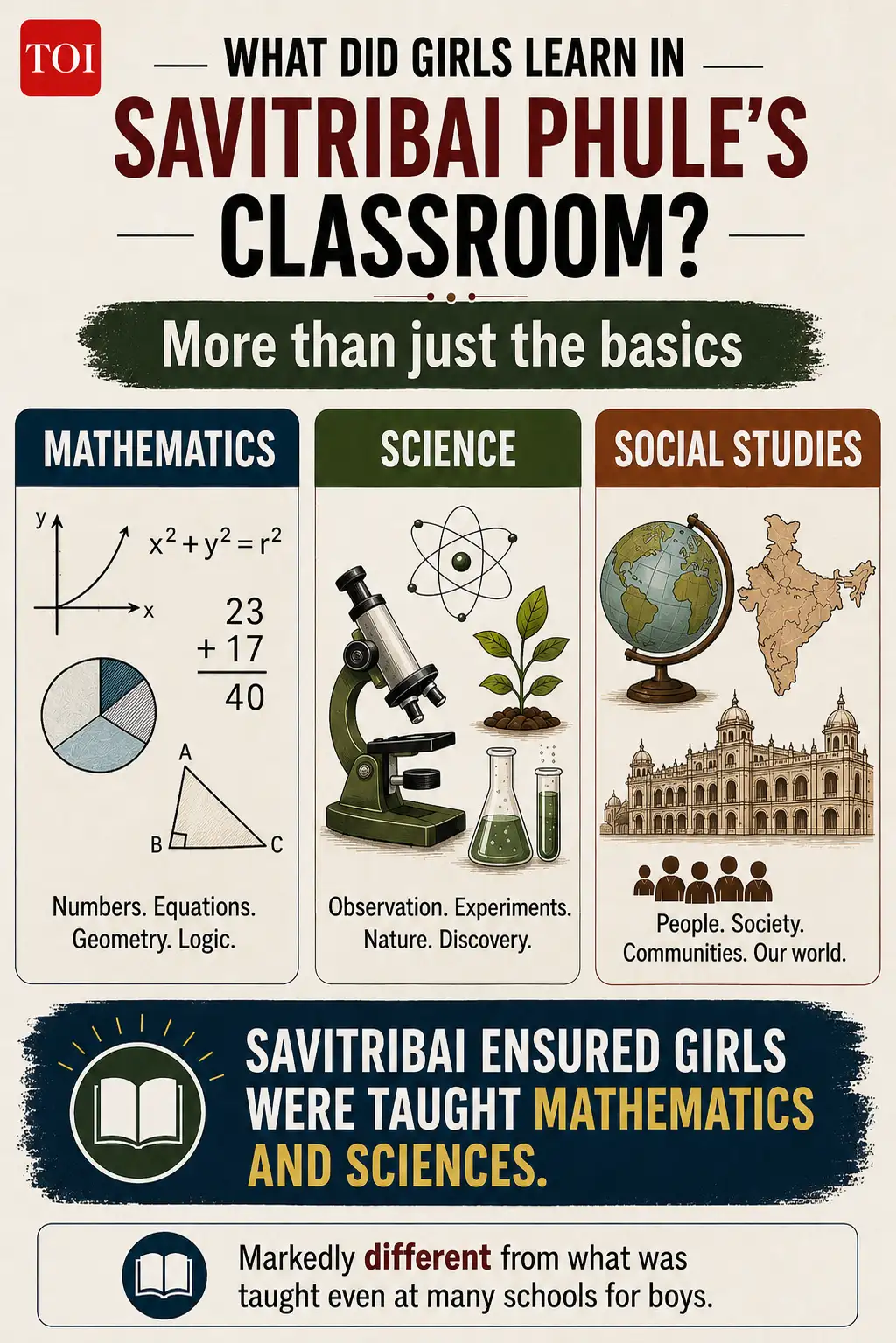
The familiar story begins at Pune’s Bhide Wada in 1848, with girls entering a school at a time when their education was restricted. The school they opened in 1848 was believed to have been the first modern school in India exclusively for girls. Education experiment that went beyond girl’s school The Government of India’s publication Savitribai Phule (1831–1897) records that Savitribai, Jyotirao and Sagunabai founded the school at Bhide Wada, where students were taught a Western curriculum including mathematics, science and social studies. By 1851, they had three schools for girls in Pune, with teaching methods that the publication says were different from those followed in government schools. In 1849, Savitribai and Fatima Sheikh opened a school. In 1850, Savitribai and Jyotirao established two educational trusts — the Native Female School in Pune and the Society for promoting the Education of Mahar, Mangs. The government publication further records that the Phules established 18 schools for children irrespective of caste. The 1850 establishment of a society specifically named for the education of Mahar and Mang communities sits alongside the broader record of 18 schools for children irrespective of caste. The Maharashtra government’s Social Welfare Department currently runs the Savitribai Phule Scholarship Scheme, established through a 1996 government resolution. Its stated objective is to reduce the dropout rate among backward-class girls studying in Classes 5 to 7 and 8 to 10. For a woman remembered primarily through one pioneering school, the government record leaves behind a much larger footprint: multiple institutions, a specific effort towards Mahar and Mang education, 18 schools across caste lines and a curriculum that went beyond the limited education often prescribed for girls.
A PIB account of Savitribai and Jyotirao Phule’s work describes education as their “chief weapon” in their efforts to fight caste and gender discrimination and work for weaker sections. The Government of India publication says the Bhide Wada school taught mathematics, science and social studies. It says the Phules viewed education in the context of a larger social agenda for change. This also explains why reducing Savitribai’s contribution to the phrase “pioneer of women’s education” misses part of the documented picture.
PUNE: What if Savitribai Phule’s most radical classroom was not the one history remembers best? But government records reveal a less-repeated part of the experiment: within just a few years, Savitribai and Jyotirao Phule had moved beyond a single school for girls to build an educational network that included children from communities kept outside the social mainstream. And one of the institutions they established had a name that leaves little room for ambiguity — the Society for promoting the Education of Mahar, Mangs. But the same record points to a much wider effort. That makes the familiar Bhide Wada episode only one part of the story. The records show an educational effort that was expanding simultaneously in terms of gender, caste and the number of institutions. Students were taught a Western curriculum The curriculum is another detail that tends to disappear behind the larger story of social reform. The Ministry of Education’s National Curriculum Framework for the Foundational Stage describes Savitribai and Jyotiba as proponents of social justice committed to marginalised communities and notes that they established schools for girls and children from vulnerable communities at a time when this was virtually unheard of. The NCF also specifically notes that Savitribai ensured girls were taught mathematics and sciences, describing this as markedly different from what was taught even at many schools for boys. So the significance of the Phules’ schools was not only in who entered them, but also in the education they received. The Government of India record adds that the ratio of girls receiving education in their schools was higher than the ratio of boys receiving education in government schools. The institutional details are perhaps the least familiar part of Savitribai’s educational story. Together, these details suggest that the Phules’ educational work was not limited to creating an alternative school for girls; it involved establishing institutions aimed at widening access to education among groups who had been left out. Her educational work intersected with a larger question: who should be allowed to learn? The answer emerging from the government records was considerably wider than the conventional classroom narrative. Savitribai Phule That question has not entirely disappeared from policy. The department lists the scheme as a state-government programme and provides scholarships for eligible girls. The connection is not simply in the name. The historical record shows Savitribai and Jyotirao expanding education towards girls and communities excluded by caste. The present-day Maharashtra scheme carrying Savitribai’s name continues to target an intersection of gender, social disadvantage and access to education.