
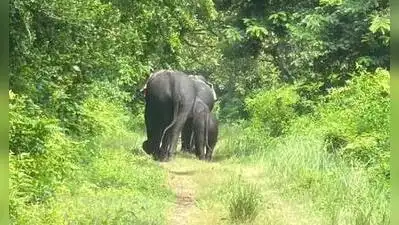
Reti-Titi corridor along Bhutan Hills and Jaldapara-Chilapata-Buxa Tiger Reserve-Nimti corridor will be restored to allow elephants to move freely without human interference
Jalpaiguri: More than two decades after they were identified, two elephant corridors in Dooars are set to be restored following clearance from Union ministry of environment and forests (MoEF).
In 2003-04, the forest department had identified four major stretches in Dooars that wild elephants regularly use as corridors. In 2003-04, after identifying the four corridors, the forest department asked the district administration (Alipurduar was then part of Jalpaiguri) to hand over possession of land, mostly vested, lying within the corridors. Only about 300 hectares of vested land was transferred to the department, where fodder grass was planted. Forest officials believe man-elephant conflict in Dooars — which claims about 50 human lives and kills 10 elephants every year — can be checked if animals are kept within forests by planting more fodder grass.
You Can Also Check: Gold Rate in Kolkata | Silver Rate in Kolkata | Bank Holidays in Kolkata | Public Holidays in Kolkata | Kolkata AQI | Weather in Kolkata | Petrol Price in Kolkata | Diesel Price in Kolkata | CNG Price in Kolkata | LPG Price in Kolkata Stay updated with the latest Kolkata news.
This was a long-pending issue, and we are hopeful that once these two elephant corridors are restored, man-elephant conflict will significantly come down,” a senior forest official said. Reti-Titi corridor along Bhutan Hills and Jaldapara-Chilapata-Buxa Tiger Reserve-Nimti corridor will be restored to allow elephants to move freely without human interference. Apart from the two approved stretches, Dhumchi-Tili-Lankapara-Bandapani corridor and Gorumara-Khairkata-Diana corridor are yet to be cleared by MoEF. “For corridor restoration, we expect implementing units to be ready by the end of this fiscal year. Restoration work is expected to begin early in the next financial year. However, the handover never materialised. “The corridors will be restored by bypassing human settlements. In most cases, the passages are occupied by tea plantations. Tea bushes will be uprooted where required, and tea gardens will be compensated. We also plan to erect fencing on two sides initially to mark the corridors. Once elephants get habituated, the fencing will be removed,” the official added. Restoring traditional passages running through forests, rifts and foothills will curb elephant raids and bring down conflict across the region. Download the TOI App.