
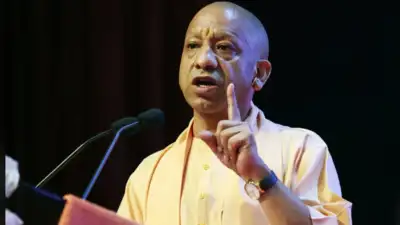
Uttar Pradesh Chief Minister Yogi Adityanath (Photo: ANI)
Uttar Pradesh Expands Economic Partnerships
Uttar Pradesh is establishing new partnerships aimed at enhancing the state’s economic, technological, and social development. This collaboration spans over 15 sectors, including semiconductors, advanced manufacturing, green hydrogen, agriculture, healthcare, logistics, skills development, tourism, and education.
While several initiatives are supported by memorandums of understanding (MoUs) and institutional arrangements, others are still in the discussion and exploration phase. The focus on diverse areas underscores the state’s commitment to fostering growth and innovation across multiple industries.
This emerged after the visit of a large Japanese business and government delegation to Uttar Pradesh in August 2026 which has opened a significant new chapter in the economic relationship between Japan and India’s most populous state. Led by Yamanashi Governor Kotaro Nagasaki, the delegation of around 240 members engaged with the Uttar Pradesh government, industry representatives, universities and other institutions in Lucknow, Noida, Agra and Varanasi. A 500-acre Japanese city A particularly significant development is the Uttar Pradesh government’s plan to establish a dedicated 500-acre Japanese City in Sector 5A, Greater Noida. Equally significant is the proposed 90-day review mechanism, which would ensure periodic monitoring of investment proposals and help address bottlenecks in implementation.
The Japanese City could therefore emerge as a premier destination for Japanese manufacturing companies, suppliers, technology enterprises and GCCs.
Institutions such as IIT (BHU) Varanasi and Madan Mohan Malaviya University of Technology could play an important role in linking academic research with industrial and technological applications, Officials said. The visit was not merely an investment road show. It reflected a larger effort to build a long-term state-to-prefecture partnership between Uttar Pradesh and Yamanashi, while creating a wider framework for Japanese investment, technology transfer, research, manufacturing, skills and cultural cooperation. This proposed township has the potential to become the physical centrepiece of the emerging Japan–Uttar Pradesh economic partnership. A dedicated Yamanashi Desk is proposed as part of the institutional support mechanism to assist Japanese investors and companies. This is expected to provide a focused interface between Japanese enterprises and the Uttar Pradesh government, helping investors navigate approvals, land, infrastructure and other requirements. It would also enable the clustering of large corporations, specialised Japanese SMEs, Indian MSMEs, research institutions and service providers. Its location in Greater Noida gives it an additional strategic advantage. The region is part of one of northern India’s fastest-growing industrial and technology belts and benefits from proximity to Noida, Delhi, the Yamuna Expressway industrial region and the upcoming Noida International Airport at Jewar. The proposed Japanese City represents an important shift in Uttar Pradesh’s investment strategy. Rather than seeking only individual factories, the state is attempting to create a complete ecosystem where Japanese companies can establish, expand and collaborate over the long term. Semiconductors and electronics : building a strategic technology ecosystem The August delegation further strengthened this direction, with Uttar Pradesh and Japan signing an MoU on green hydrogen cooperation envisaging knowledge sharing, technology exchange, joint research and policy support. The significance of this partnership lies in its ecosystem-based approach. The objective is not simply hydrogen production but the development of capabilities in technology, research, skills, industrial applications and clean-energy infrastructure. Renewable energy and green infrastructure
During Chief Minister Yogi Adityanath’s Japan outreach earlier in 2026, Uttar Pradesh and Yamanashi developed plans for a Centre of Excellence on Green Hydrogen. It now encompasses: Decidedly, the proposed 500-acre Japanese City in Greater Noida adds a physical dimension to this vision. With plug-and-play infrastructure, a dedicated Yamanashi Desk and a 90-day review mechanism, it could become an institutional gateway for Japanese companies seeking to establish or expand their presence in Uttar Pradesh. The August 2026 visit of the large Japanese delegation followed Chief Minister Yogi Adityanath’s Japan outreach earlier in the year, underlining that this relationship is being developed as a continuing institutional process rather than a one-time investment event.
A structured skill partnership could therefore connect trained manpower with Japanese industrial requirements while creating new employment opportunities for the state’s youth. The proposed partnership across more than 15 sectors therefore has the potential to develop into one of the most comprehensive economic relationships between Japan and an Indian state. Uttar Pradesh and Yamanashi Prefecture have signed a tourism cooperation agreement aimed at encouraging greater two-way tourist movement, joint promotion and cultural exchange. You Can Also Check: Gold Rate in Lucknow | Silver Rate in Lucknow | Bank Holidays in Lucknow | Public Holidays in Lucknow | Lucknow AQI | Weather in Lucknow | Petrol Price in Lucknow | Diesel Price in Lucknow | CNG Price in Lucknow | LPG Price in Lucknow Stay updated with the latest Lucknow news.
The proposed township is envisaged as more than a conventional industrial area. Equipped with world-class plug-and-play infrastructure, it is expected to provide Japanese companies with an ecosystem designed specifically to facilitate manufacturing, technology investments and the establishment of Global Capability Centres. Semiconductors have emerged as one of the most strategically significant areas of prospective cooperation. A Japanese expert team is expected to examine opportunities within Uttar Pradesh’s emerging semiconductor ecosystem, while discussions have also focused on deeper engagement with Japanese semiconductor industry bodies and technology companies. Japan possesses globally recognised capabilities in semiconductor materials, manufacturing equipment, precision engineering and specialised electronic components. Uttar Pradesh, meanwhile, is seeking to establish itself as an important destination for electronics and semiconductor manufacturing. The potential collaboration is not confined to semiconductor fabrication plants alone. It could extend across semiconductor materials, manufacturing equipment, specialised components, testing and packaging, embedded systems, research and development, electronics design and associated supply chains. The proposed Japanese City in Greater Noida could provide an additional platform for such companies, particularly those involved in electronics, specialised components, advanced manufacturing and technology services. Automobiles, EVs and advanced mobility Automobiles and electric mobility constitute another major pillar of the proposed partnership. Japanese companies have long been global leaders in automobiles, motorcycles, automotive components and efficient manufacturing systems. Uttar Pradesh offers a large domestic market, expanding industrial infrastructure and rapidly improving road, rail and air connectivity. Discussions have involved major Japanese companies including Suzuki, Honda and DENSO, covering automobiles, motorcycles, electric vehicles, motor generators and sustainable mobility technologies. A DENSO-related proposal, for instance, has focused on the possibility of establishing a motor-generator manufacturing facility for EVs in Gautam Buddha Nagar. The scope of future cooperation could include EV manufacturing, batteries and associated systems, automotive electronics, electric motors and generators, precision components, sustainable mobility solutions, research and innovation. The clustering of Japanese and Indian companies in dedicated industrial ecosystems could further strengthen automotive supply chains and generate opportunities for local component manufacturers and MSMEs. Precision engineering and advanced manufacturing Japan’s global strength in precision manufacturing complements Uttar Pradesh’s objective of moving from conventional industrial production towards high-value and technology-intensive manufacturing. Precision engineering, industrial machinery, automation, robotics and high-quality industrial components are among the important areas under discussion. Automotive manufacturing, electronic components and precision engineering have been identified as significant areas of engagement with Japanese corporations. A major benefit for Uttar Pradesh could be the transfer of Japanese manufacturing practices, quality standards and production systems. The philosophy of continuous improvement, associated with Kaizen, could help local enterprises improve productivity, quality and competitiveness. The larger opportunity lies in integrating Uttar Pradesh’s extensive MSME base with Japanese and global supply chains. Green hydrogen: a new institutional pillar Among all the emerging sectors, green hydrogen appears to be one of the most clearly institutionalised areas of Japan–Uttar Pradesh cooperation. The proposed collaboration focuses on research, innovation, technology development, skill enhancement and pilot implementation. The cooperation framework extends beyond hydrogen to renewable energy, sustainable infrastructure and environmentally responsible urban development. Japanese corporations have shown interest in renewable energy, green infrastructure, smart cities and next-generation construction technologies. This could create opportunities for collaboration in energy-efficient buildings, sustainable industrial parks, clean-energy systems, waste reduction and environmentally responsible infrastructure. As Uttar Pradesh develops new industrial townships, expressway-linked manufacturing zones and urban infrastructure, Japanese expertise in efficient design, technology and sustainable construction could become increasingly relevant. Agriculture, agri-tech and food processing Agriculture represents another major area of opportunity. Uttar Pradesh possesses one of India’s largest agricultural economies, while Japan has developed advanced capabilities in precision agriculture, mechanisation, post-harvest management, food processing and cold-chain technologies. Recent discussions have included agri-tech and food processing, opening possibilities for cooperation in agricultural technology, mechanisation, storage, cold chains, value addition, supply-chain management and technology-enabled farming. For Uttar Pradesh, the objective would be to move beyond the production of raw agricultural commodities and increase the value derived from processing, branding and efficient supply chains. Japanese technology could help improve productivity and reduce post-harvest losses while creating new opportunities for food-processing enterprises and farmer-linked industries. Pharmaceuticals, medical technology and healthcare Healthcare, pharmaceuticals and medical technology are also emerging as promising areas of engagement. More recent investor interactions have continued to highlight opportunities in med-tech and advanced healthcare technologies. This aligns with Uttar Pradesh’s efforts to expand medical infrastructure and develop pharmaceutical and medical-device manufacturing clusters. Potential areas of collaboration include medical equipment, diagnostics, biotechnology, pharmaceuticals, healthcare research and advanced clinical technologies. Biotechnology, robotics and artificial intelligence Another significant possibility is the development of a bio-innovation ecosystem based on successful Japanese models. Such a cluster could bring together research institutions, laboratories, companies, entrepreneurs and technology developers, creating a bridge between scientific research and commercial applications. The partnership could eventually support biotechnology, pharmaceuticals, diagnostics, agricultural biotechnology and other life-science applications. Japanese investors have also expressed interest in robotics, med-tech and innovation laboratories. Japan’s expertise in industrial robotics and automation could complement India’s strengths in software, artificial intelligence and engineering talent. Uttar Pradesh, which is seeking to expand its technology ecosystem and attract Global Capability Centres, could benefit significantly from this convergence. Defence manufacturing Defence manufacturing is another strategically important area of discussion. Uttar Pradesh’s Defence Industrial Corridor provides a platform for manufacturing defence equipment, components and associated technologies. The state’s growing industrial infrastructure offers opportunities for Japanese companies in precision engineering, electronics, advanced materials and specialised manufacturing technologies. The potential cooperation may be particularly relevant in areas where Japanese engineering capabilities can complement India’s objective of strengthening indigenous manufacturing. Logistics, warehousing and industrial infrastructure Japan’s expertise in logistics and supply-chain management is highly relevant as Uttar Pradesh seeks to position itself as a major manufacturing and logistics hub. Previous discussions with Japanese companies have covered logistics, warehousing, industrial infrastructure and integrated logistics facilities. The proposed Japanese City would add another dimension to this infrastructure ecosystem by providing companies with a concentrated, investor-oriented industrial environment. The Yamuna Expressway, Greater Noida industrial region, Noida’s technology ecosystem, the upcoming Noida International Airport and dedicated freight infrastructure together provide a strong proposition for Japanese manufacturing and logistics companies. MSMEs: linking Uttar Pradesh with Japanese supply chains One of the most important dimensions of the partnership is the potential participation of Japanese small and medium enterprises. Japan’s industrial strength rests not only on large corporations but also on a highly developed network of specialised SMEs. Uttar Pradesh, too, possesses a vast MSME ecosystem across manufacturing, handicrafts, engineering, food processing and other sectors. The Yamanashi relationship has included efforts to facilitate opportunities for small and medium enterprises. This could create a deeper industrial ecosystem in which Japanese SMEs work alongside Uttar Pradesh-based enterprises as suppliers, technology partners and joint-venture collaborators. For local MSMEs, the benefits could include exposure to global quality standards, technology transfer, improved production systems and possible integration into international supply chains. Skill development and employment The proposed partnership is not limited to capital investment and industrial projects. Skills and workforce development are emerging as an equally important pillar. The two sides have discussed cooperation in skill development and employment with the objective of preparing Uttar Pradesh’s young workforce for Japanese manufacturing and technology ecosystems. Japanese-language training, technical education, industrial training, apprenticeship models and exchange programmes could become important components of this collaboration. Japan faces workforce and demographic challenges, while Uttar Pradesh possesses one of India’s largest young populations. Tourism, culture and Buddhist heritage Tourism gives the Japan–Uttar Pradesh relationship a distinctive civilisational dimension. Buddhist, spiritual and wellness tourism are among the important areas of focus. Uttar Pradesh is home to globally significant Buddhist destinations including Sarnath, Kushinagar and Shravasti. These centres have the potential to attract greater numbers of Japanese visitors through targeted promotion, improved tourism infrastructure and cultural exchanges. At the same time, Agra and the Taj Mahal can form part of a wider India–Japan tourism circuit, while Varanasi offers opportunities in spiritual, cultural and heritage tourism. Education, research and institutional cooperation The partnership is also expanding into universities, research institutions and academic collaboration. The proposed Green Hydrogen Centre of Excellence, involving institutions such as IIT (BHU) Varanasi and Madan Mohan Malaviya University of Technology, illustrates how industrial cooperation can be linked with academic research and skill development. This model could eventually be extended to semiconductors, engineering, healthcare, biotechnology, robotics and advanced manufacturing. Joint research programmes, student and faculty exchanges, technology transfer and industry-academia partnerships could help build a long-term institutional foundation for the relationship. From investment promotion to a Japan–UP economic corridor What distinguishes the latest engagement is its breadth and the attempt to create permanent institutional and physical infrastructure for the partnership. The emerging framework is far more comprehensive than the conventional model of inviting companies to establish individual manufacturing units. The partnership can broadly be understood through four interconnected pillars of manufacturing, technology and innovation, sustainable development and people-to-people and institutional cooperation. involving skills, employment, education, tourism, Buddhist heritage and cultural exchange. For Uttar Pradesh, the larger opportunity lies in combining Japanese technology, manufacturing discipline and innovation with the state’s market size, young workforce, improving infrastructure and expanding industrial base. The proposed Japanese City could serve as a major platform for this convergence. For Japan, Uttar Pradesh offers access to a vast market, a large pool of human resources, rapidly expanding infrastructure and an industrial ecosystem that is diversifying beyond traditional sectors. Download the TOI App.
Earlier interactions involving Japanese technology companies such as Renesas and Tokyo Electron have also highlighted opportunities in semiconductor technologies, advanced electronics and Global Capability Centres. Earlier interactions with Japanese pharmaceutical and biotechnology organisations explored possibilities relating to joint research and development, clinical research, diagnostics and medical devices.