
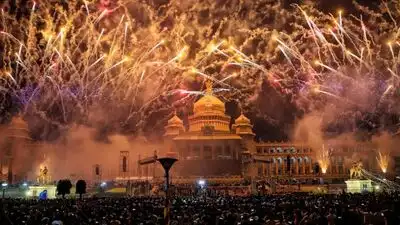
Fireworks light up the sky over the Vidhana Soudha during a musical event as part of the ‘Freedom Habba’ carnival to mark the 80th Independence Day, in Bengaluru, Karnataka. (PTI Photo, File)
One of Bengaluru’s most recognisable landmarks was built in just four years in the 1950s, with around 5,000 prisoners forming a major part of the workforce that constructed it. Construction of Vidhana Soudha began in 1952, after its foundation stone was laid by then Prime Minister Jawaharlal Nehru on July 13, 1951. The massive building was completed in 1956 and became the seat of Karnataka’s legislature. The building was closely associated with Kengal Hanumanthaiah, who became chief minister of the then Mysore State in 1952.
Hanumanthaiah wanted the new legislature building to have an unmistakably Indian character.
It stretched about 700 feet in length and 350 feet in width, while the dome rose around 150 feet from floor level. The design was prepared by government architect and chief engineer BR Manickam. It brought together elements of Dravidian and Rajasthani architecture and eventually became associated with the Neo-Dravidian style. The building was constructed largely with stone and featured a large central dome. The structure was designed to house both the legislature and the secretariat. Its grand scale was deliberate. Vidhana Soudha was meant to be more than an administrative building — it was also intended to represent the political changes that followed Independence.