
China’s 24MW underwater data centre off Shanghai runs 2,000 servers cooled by seawater and powered by an offshore wind farm, six years after Microsoft pulled 855 servers out of the North Sea and shelved the idea.
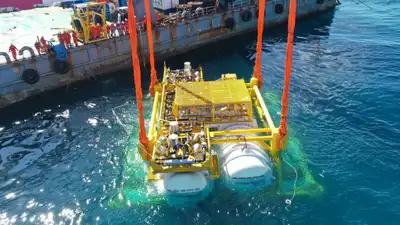
China has switched on a commercial underwater data centre off the coast of Shanghai, dropping roughly 2,000 servers onto the seabed in the Lingang Special Area and wiring them directly into an offshore wind farm. The facility runs at 24MW, sits 10 metres below the surface and more than 10km out, and uses the surrounding seawater in place of chillers and cooling towers. It took 1.6 billion yuan of investment, roughly Rs 2,100 crore, and is a joint effort between HiCloud Technology and state-owned China Communications Construction. In 2018 the company lowered a white steel cylinder the size of a shipping container 117 feet under the North Sea off the Orkney Islands, with 855 servers inside and 27.6 petabytes of storage.
Commercial operations began in May, after trials in February and construction wrapping up last October. The design it borrows from belongs to Microsoft. The air was pumped out first and replaced with dry nitrogen, so nothing inside could oxidise or take on moisture. Two years later Microsoft pulled it back up, published results better than anyone expected, and then walked away from the idea entirely.
Underwater Data Centers: Performance and Efficiency
Recent developments in underwater data center technology highlight significant performance advantages. In a notable experiment, Microsoft reported a failure rate of just 0.7% for its submerged servers, losing six out of 855 units. In contrast, a control group operating in a traditional land-based facility experienced a failure rate of 5.9%, losing eight out of 135 servers.
This disparity can be attributed to two primary factors: the cold seawater, which effectively dissipates heat without additional energy costs, and a sealed nitrogen-filled environment that minimizes corrosion and physical damage, prolonging hardware lifespan. The experiment achieved a Power Usage Effectiveness (PUE) of 1.07, significantly better than the industry average of over 1.5 at that time, demonstrating the potential of submerged technology to reduce energy consumption.
Building on this success, the Shanghai pod is actively deploying GPU clusters for AI training and big data tasks, managed by China Telecom and local service providers. It boasts a PUE of approximately 1.15, a 22.8% reduction in electricity usage, and requires more than 90% less land compared to similar onshore facilities. The Chinese government reports that the project aims to operate on over 95% green electricity.
HiCloud initiated its underwater server operations off Hainan in 2021 and launched its first commercial modules in 2023. Future plans include scaling up to 500MW, leveraging offshore wind energy for sustainable operations.
A United Nations university institute warned this week that the water footprint of data centres could hit 9.3 trillion litres by 2030, roughly what the entire population of sub-Saharan Africa uses domestically in a year. Microsoft confirmed in 2024 that its subsea programme was over. Around 90% of the world’s AI data centre capacity now sits in those two countries.
Rick Stafford, a marine biologist at Bournemouth University, said cooling with seawater does raise local temperatures but that the effect will “not be far reaching”. Noelle Walsh, who runs the company’s cloud operations and innovation group, said flatly that she was not building subsea data centres anywhere in the world. The timing is what makes an old experiment relevant. In a land-based facility, somewhere between a quarter and half of total electricity demand goes to moving chilled water around the servers. Training clusters are pushing density past what ordinary buildings can handle, and grid operators in Virginia and Texas have started resisting new data centre connections. A sealed module offshore avoids both halves of the problem. The sea absorbs the heat, the turbines overhead supply the electricity, and no aquifer gets touched. The obvious objection is that a heat source on the seabed is still a heat source. Researchers who study coastal ecosystems say the risks, including disturbed sediment and warmer water immediately around the modules, look manageable but need monitoring over time. Microsoft’s own cylinder came back up wearing algae, barnacles and anemones grown to the size of melons, which answered a question nobody had asked about whether sea life would mind the hardware. The reasoning was practical rather than technical. Sending a technician down in a strong current to fix a failed board is expensive, saltwater still eats steel, and Microsoft has been building on land at a pace it has no reason to slow. A researcher at Hong Kong Polytechnic University put the gap simply: Microsoft got to the concept first, while China had the market demand, marine engineering and policy backing to turn it into a working commercial site. Get the latest technology news and updates. Download the TOI App.