
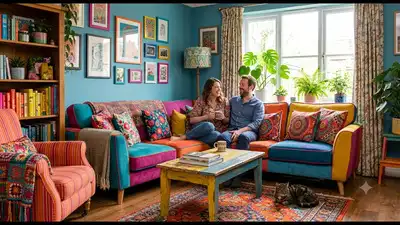
Nothing like a pop of colour in your home to instantly lift mood. Get rid of beige.
Off went everything beige and colourless — from walls, sofas rugs, curtains, even kitchens which for 20 years had looked like they had been designed in variations of colours of coffee with milk. Because these were highrises, mostly. Because it does not have to be permanent, this makes colour less intimidating.
So, during the pandemic lockdown, when people were home, they finally got a chance to catch up with “home business”. In the 1990s, style and make-up were all about muted shades, nude or beige or brown lipstick and white or neutral shade clothes. This was the anti-colour movement which significantly wanted to shift away from the Big and Bold and Colourful and Funky style of the 1980s. Well, it didn’t last long. Nothing without colour lasts long. Over the years, as the idea of a home became mostly investing in an apartment—for the last two decades—people chose muted colours and many shades of beige for its walls. And dust settles quite quickly. Muted colours and beige was a practical option. Then mostly these flats were bought by nuclear families with both partners working. So there was no time to think about the upkeep of the house. Life got busy. Life was 24×7. Then life became quite dull and depressing, frankly. And they wanted colour. The return of colour is part of a broader reaction to the sameness of minimalist interiors. The neutral home had its advantages, but living in one can sometimes feel like all the joy has been snatched away from our lives. As homes increasingly became backdrops for social media, the pressure to keep everything coordinated also grew. The result was a generation of interiors that looked remarkably similar, whether they were in Mumbai, Delhi, Bengaluru or London. The desire now is to create spaces that feel lived in rather than staged. A blue wall inherited from an old family home, a green cabinet, a red chair or patterned cushions can tell a story that another shade of beige simply cannot. What is returning now is not necessarily the maximalist home packed with every possible colour. Instead, homeowners are becoming more confident about using colour strategically. A neutral room might have a deep green wall, a cobalt blue sofa, mustard cushions or a terracotta console. Kitchens are experimenting with coloured cabinetry. Bathrooms are moving beyond white tiles. Even ceilings, often forgotten in interior design, are being painted in unexpected shades. The idea is not to make every surface compete for attention but to give certain elements enough personality to become memorable. There is also a generational shift. Younger homeowners are not really interested in buying furniture that is supposed to last visually for decades. They want to experiment – repaint a wall, change cushions or buy a brightly coloured second-hand piece. That way, the home becomes something that evolves rather than a finished project.