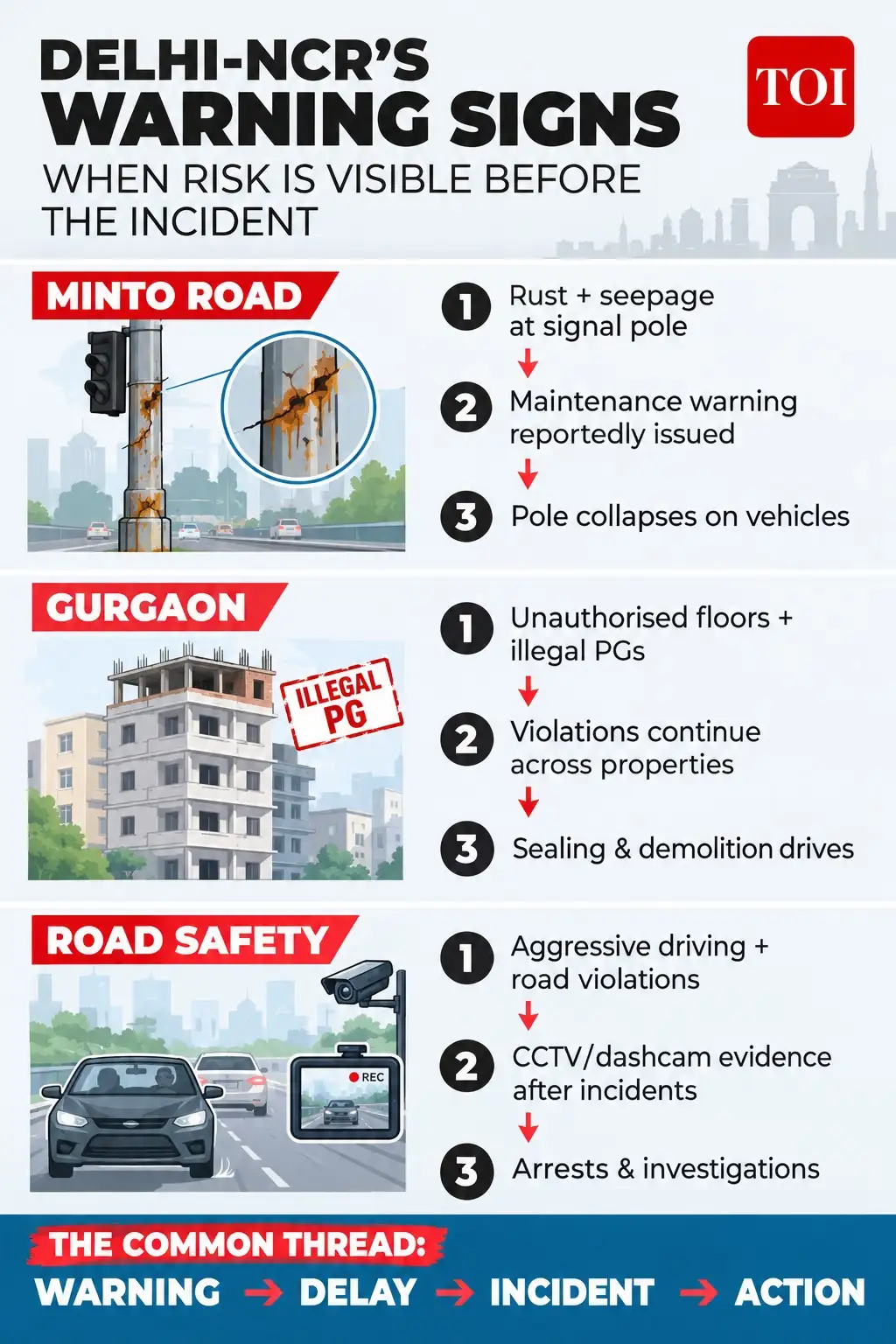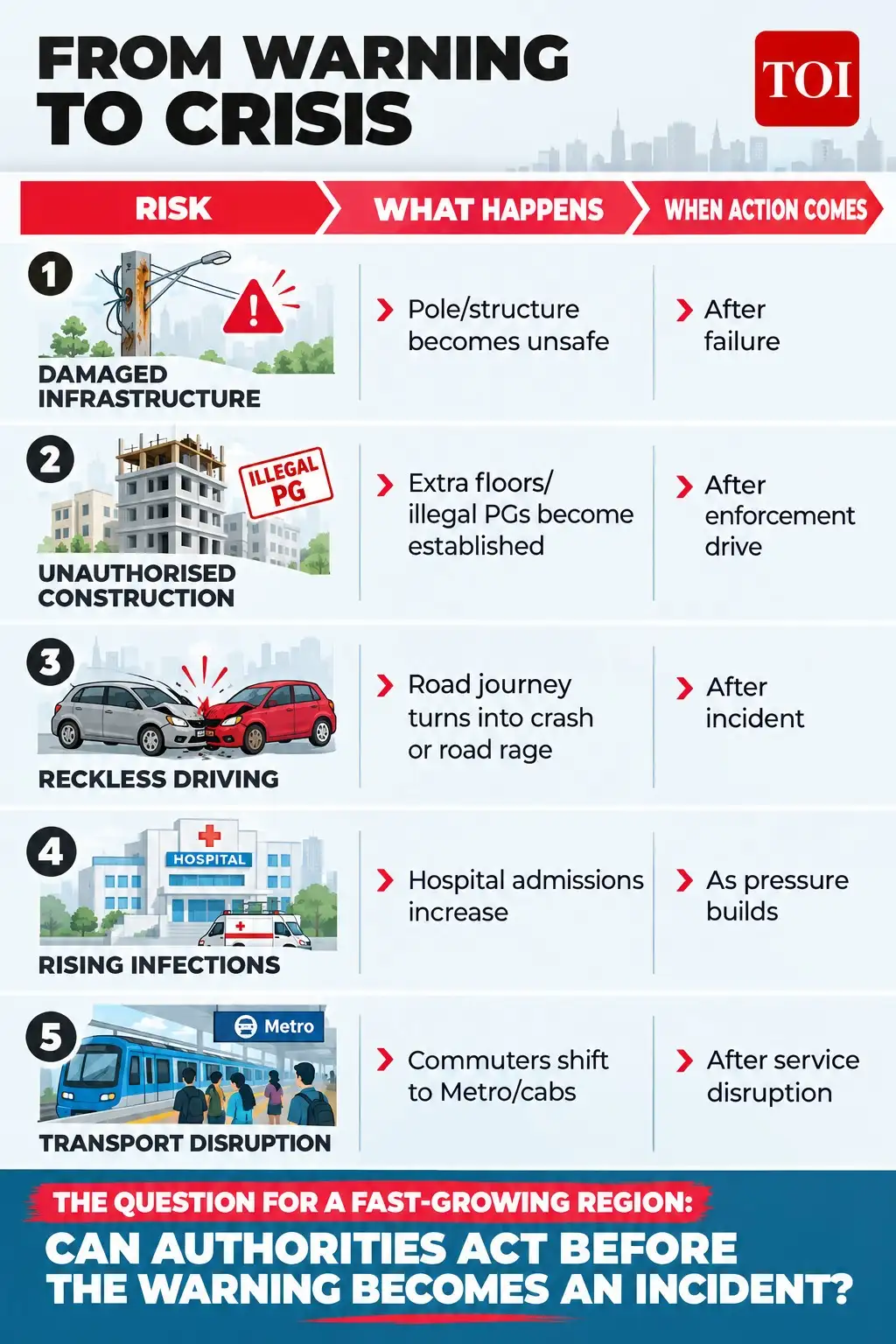
Delhi-NCR faces recurring incidents due to ignored warning signs and system failures.
The pole was installed in 2010 and was reportedly showing some visible wear, such as rust around the bottom. A 32-year-old man met with an accident in wee hours of September 5 when he was hit by a car at Ek Murti Chowk. The 24-year-old driver was later arrested and the vehicle impounded by police.
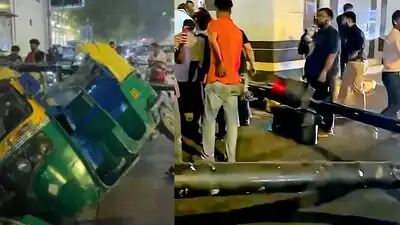
More importantly, sources said the agency that maintains it had been alerted to the need for repairs about five days before the collapse. NEW DELHI: Delhi-NCR has been witnessing a spate of incidents in the past few days that do not seem to have much in common on the face of it — a traffic signal pole crashing on vehicles at Delhi’s Minto Road, action on unauthorized construction and illegal PGs in Gurgaon, road rage and hit-and-run cases and disruptions to public transport. But look closer, and you start to see a familiar pattern. The bigger question is whether the region’s civic and enforcement systems are doing enough to act on those warning signs before they turn into accidents or public crises. Two people were hurt when the pole came down, and police are investigating whether seepage and rust weakened its base. That makes the incident more than a matter of why the pole fell. It poses the more uncomfortable question of what happened in between the warning and the accident. Infrastructure in a city usually does not suddenly break down without some indication that it is deteriorating. Rusts, cracks, water seepages, loose fixtures, damaged pavements and broken street lights can remain visible for weeks or months. The problem is not often identifying the problem, but getting someone to own it, record it, fix it and check that the repair has actually been done. If that chain breaks at any point, what might have been a fairly routine maintenance issue can quickly become a public safety incident. The road-rage incident on Gurgaon’s Golf Course Road brings the issue to a more personal setting. Footage shot on her motorbike, as well as CCTV footage, proved to be vital to the investigation into a woman on a motorbike being chased and rammed by a car. The police have constituted a five-member SIT and arrested two accused and taken them into custody for crime-scene reconstruction. The FIR was later enhanced to include charges relating to stalking, outraging the modesty of a woman and attempt to murder. Another incident in Greater Noida demonstrated how quickly a routine road journey can become life-changing injuries. He suffered multiple fractures in his legs, hand, knees and spine. The facts are different from the Gurgaon road-rage incident, but both highlight the same vulnerability: speed, aggression or poor road discipline entering equation can turn a normal journey into a serious safety incident in seconds. There is also an increasing reliance on cameras and video to reconstruct what happened after an incident. Increasingly, police are using CCTV footage, dashcams and recordings on mobile phones to identify vehicles, establish sequences of events and find suspects. That helps with investigation, but it’s ultimately a response mechanism. The tougher job is to build the roads and enforcement regimes that catch and deter reckless behavior before anyone gets hurt.
Sometimes there were warning signs, violations or risks well before the incident itself. When accident is preceded by warning Such a case is the collapse of a traffic signal pole on vehicles at Minto Road in central Delhi on Tuesday night.