
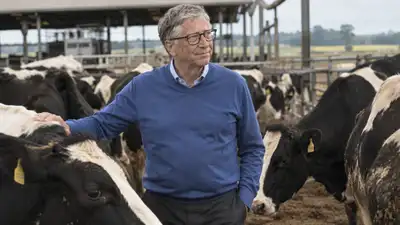
Representative AI image
Breakthrough Energy Ventures, founded by Bill Gates, led Rumin8’s US$12 million Phase 2 seed funding round announced on 23 January 2023. Methane has an atmospheric lifetime of roughly a decade, much shorter than carbon dioxide, but its warming effect is considerably stronger over the first 20 years after release. Because ruminant livestock, including cows, sheep and goats, release methane, a powerful greenhouse gas, during digestion, making livestock emissions an important target for climate action, cattle farming is attracting attention from climate scientists and technology companies.
Rumin8 has reported progress in animal trials and commercial development, but company-reported results should be distinguished from independent evidence of large-scale performance. Bill Gates-backed climate investment firm Breakthrough Energy Ventures has invested in Rumin8, an Australian start-up developing technology to reduce methane emissions from livestock. The company is exploring synthetic feed additives that target methane production inside a cow’s digestive system. The approach could offer a way to reduce the climate impact of cattle farming without eliminating livestock production. However, promising laboratory and animal trial results do not automatically guarantee commercial success. Researchers and farmers must also consider safety, cost, long-term effectiveness and whether the technology can be used across different farming systems. Australian climate technology company Rumin8 is developing feed additives designed to reduce methane emissions from livestock. The investment was intended to support commercial trials in Australia, New Zealand, Brazil and the US, alongside product development and pilot manufacturing. Rumin8’s approach involves identifying naturally occurring compounds with anti-methanogenic properties and reproducing them synthetically. Its work focuses on creating consistent, scalable additives for livestock. The funding announcement established the company’s commercialisation ambitions, but it did not mean the technology had already received regulatory approval or reached widespread commercial use. Cattle produce methane through a natural digestive process called enteric fermentation. Unlike humans, cows have a specialised stomach system that allows microorganisms in the rumen to break down fibrous plant material. This microbial activity generates hydrogen and other compounds. Methanogenic archaea use hydrogen to produce methane, which cattle mainly release through belching. The Food and Agriculture Organization of the United Nations identifies livestock as a major source of agricultural methane, primarily through enteric fermentation and manure management. Reducing methane emissions can help slow the rate of warming in the near term. The FAO identifies improvements in animal nutrition, health, genetics and farming practices as potential ways to reduce emissions while supporting livestock productivity. Feed additives such as those being developed by Rumin8 represent one technological approach within this broader set of interventions. The potential climate benefits of methane-reducing feed additives depend on whether they can be used safely, consistently and affordably. Researchers must assess the long-term effects on animal health, productivity, rumen function and food safety. They must also establish whether the products remain effective when administered under different diets and farming conditions. Delivery is another challenge. Cattle in feedlots can receive measured quantities of additives through their feed, while grazing animals may be harder to supplement consistently. Manufacturing costs, supply chains and regulatory requirements will also influence whether the technology can be adopted widely. The technology remains under development and requires further validation before its full climate potential can be established. Bill Gates-backed investment in Rumin8 reflects growing interest in technological solutions to agricultural greenhouse gas emissions. Research into synthetic bromoform, seaweed-derived compounds and other feed additives is exploring ways to reduce methane production without necessarily reducing livestock numbers. Changing what cattle release into the atmosphere could become one part of climate action. Whether it delivers meaningful reductions at global scale will depend on scientific validation, responsible regulation, farmer adoption and its integration with wider efforts to reduce livestock emissions. Get the latest technology news and updates. Download the TOI App.
Methane Reduction Potential Under Experimental Conditions
Recent studies indicate that significant reductions in methane emissions are achievable under specific experimental conditions. However, the effectiveness of these methods can vary based on the products used, the dosage administered, and the farming systems in place. To fully assess the long-term safety, effectiveness, and commercial viability of these methane reduction strategies, further research is essential.
It has a shorter atmospheric lifetime than carbon dioxide but a higher warming effect per tonne over a 20-year period. A peer-reviewed study published in Translational Animal Science on 1 March 2025 examined Rumin8’s investigational veterinary products in 24 Angus beef steers. The oil-based product produced approximately 95% reductions in methane production and methane yield under the trial conditions. A separate study published in Animal Nutrition in 2025 investigated a powdered synthetic bromoform additive in 16 Hereford × Friesian heifers fed fresh pasture. The study reported methane-yield reductions of 16% at 300 milligrams of bromoform per day and 24% at 500 milligrams per day compared with the control group.
Reducing methane emissions can therefore help slow the rate of warming in the near term. The study reported no significant effects on animal production parameters or measured rumen environment variables. Researchers also reported no treatment effect on feed intake and no detectable bromoform accumulation in muscle or fat under the conditions tested.
Methane is a greenhouse gas that contributes to global warming. Cattle methane is only one part of livestock’s climate impact, which also includes emissions from manure, feed production and land use. Rumin8’s technology uses synthetic bromoform, a compound that can interfere with the biochemical pathway responsible for methane production. Bromoform binds to reduced vitamin B12 and inhibits a key step in methanogenesis, the process through which methane-producing microorganisms generate the gas. The approach is intended to reduce methane emissions while maintaining the animal’s ability to digest feed. However, bromoform is volatile, creating challenges around stabilisation and consistent delivery. Rumin8 is investigating formulations that can address these issues. Researchers tested oil and powder formulations containing synthetic bromoform. However, the powder formulation did not significantly reduce methane at the lower tested dose, demonstrating that product formulation and dosage are important. The authors emphasised that further research was necessary. The results are promising but should be interpreted carefully. The experiment was conducted under controlled conditions and involved a relatively small number of animals. It does not establish that the same reduction will occur across all cattle breeds, diets or commercial farms. The research examined three dosage levels and a placebo control. The findings suggest that the additive may work in pasture-fed cattle, but the magnitude of the reduction differed from the results of the oil-based feedlot trial. The pasture study’s smaller methane reductions reinforce the importance of testing products in different farming environments.