
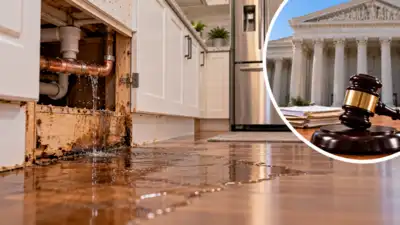
Image AI generated
During its initial investigation, State Farm received photographs and information from the restoration company and arranged an inspection of the property on June 24, 2020. On June 30, another State Farm representative emailed Nargizyan stating that coverage appeared to have been extended for the necessary repairs and clean-up, although the investigation remained open and subject to a reservation of rights. Claim specialist John Foster observed that a pipe beneath the raised foundation had burst and sprayed water into the surrounding framework, where it was absorbed by the insulation. His inspection notes also referred to limescale buildup and black compression repair tape on the pipe. After reviewing a video supplied by Nargizyan, Foster described the water as spraying out at a rapid rate, estimating that it was releasing more than three cups per minute. Importantly, his notes stated that the incident did not appear to involve continuous or repeated leakage and that the policy provided coverage for the resulting damage.
How the 2020 kitchen floor leak became an insurance dispute
A California homeowner whose kitchen floor tiles turned unusually warm in June 2020 discovered a leaking hot-water pipe beneath his house, triggering an insurance dispute that has now been before an appeals court. Nargizyan discovered the problem on June 6, 2020, when he noticed that the tiles on his kitchen floor felt warmer than usual, according to the court’s judgment. Nargizyan subsequently contacted ServPro, a restoration company, on June 8 to begin cleaning and assessing the damage. He reported the water loss to State Farm on June 9.
It maintained that a genuine dispute over coverage existed and that its decision was therefore not unreasonable.
He described seeing water dripping from numerous places, with some drops falling faster than others, although he said it was “not pouring like a faucet”. The crawl space contained approximately one and three-fourths inches of hot water, while the insulation, wooden joists and plywood subfloor had become saturated, according to information provided to the insurer during its investigation. Levon Nargizyan’s claim was rejected by State Farm General Insurance Company, which argued that the water damage resulted from continuous or repeated leakage excluded under his policy. However, California’s Second Appellate District has reversed a lower court ruling in the insurer’s favour, finding that unanswered questions about how long the pipe had leaked and whether the insurer properly investigated the claim must be examined further. After investigating, he found water dripping from the ceiling of the crawl space beneath his house. He contacted a plumber, who identified a damaged hot-water pipe in the crawl space. The plumber explained that water was spraying upwards from the pipe, soaking the insulation, wooden structures and flooring above it. The damaged section was removed and replaced, stopping the leak. Marble kitchen tiles were also discoloured, and the damage assessment indicated that sections of the kitchen flooring and the hardwood floor in the adjoining living room would need to be removed and replaced. The appeals court also considered Nargizyan’s claim that State Farm had breached the implied covenant of good faith and fair dealing by failing to investigate the water damage adequately. State Farm argued that it had conducted a full investigation, consulted the homeowner, plumber, restoration company and public adjuster, and relied on an independent engineering report before making its decision.
Why State Farm’s claims investigation and denial faced further legal scrutiny
He maintained that June 6 was the first time in the ten years since he had built the house that he had noticed a temperature change in the kitchen floor. Nargizyan disputed that interpretation. He also argued that he had acted immediately after discovering the problem, contacting a plumber who repaired the pipe. His evidence included photographs and video showing water spraying from the damaged section, as well as the absence of pooled water, muddy soil and mould in the crawl space. His mechanical engineering expert, Richard Mumper, also questioned whether a screw or nail had caused the hole. Mumper identified a chemical reaction on the pipe’s surface as another possible explanation, stating that the formation of a pinhole through chemical etching would not necessarily take a long time. He also criticised the forensic investigation for failing to establish how long the leak had existed. However, the appellate judges found that questions remained about whether the investigation had been sufficiently thorough and fair. They noted that the engineering report did not estimate the likely duration of the leak, despite the insurer relying on the continuous leakage exclusion. The court also considered the objections raised by Nargizyan’s public adjuster and mechanical engineering expert concerning the proposed cause of the pinhole. The judges concluded that a reasonable jury could find that State Farm had failed to investigate the likely duration of the leak adequately and had ignored available evidence and alternative explanations before denying the claim.