
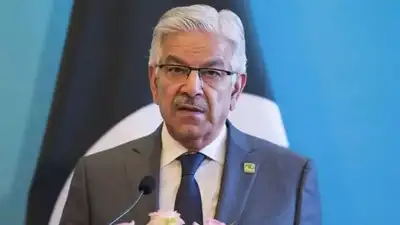
File photo: Pakistan defence minister Khwaja Asif
The pact was signed on August 7 and states that an armed attack against any one of the three members would be regarded as an attack against all. Because “this is not only in the interest of Pakistan and Iran, but also the entire region and beyond, he said Pakistan had long advocated peace and stability in the region. The trilateral Mecca defence agreement, signed by Pakistan, Saudi Arabia and Turkiye last month, establishes a framework for collective deterrence and stipulates that an armed attack against any one of the three countries would be regarded as an attack against all. The attacks have also put the newly signed defence pact under scrutiny.
Pakistan defence minister Khawaja Asif said Islamabad was fully prepared to fulfil its obligations under the pact. “The Mecca Agreement applies to us, and we will fulfil our duty,” Asif was quoted as saying by Geo News. Asif’s comments came after Saudi authorities said their air defences had intercepted and destroyed a Houthi drone south of Mecca. The drone was destroyed before entering the city’s prohibited airspace, according to Saudi authorities. “If Mecca is attacked, there is no need for an agreement to protect it,” Asif was quoted as saying. He said Pakistan did not need a formal agreement to protect the Muslim holy sites and that safeguarding them was a duty even without the pact. Asked whether any mechanism had been devised for Pakistan to help thwart recent Houthi attacks in Saudi Arabia, Khan said Pakistan remained committed to “implementing” the agreement. “However, when, how, where and what force will be used against what objectives, in which modes and matters — operational confidentiality requires us to be discreet at this stage,” he said. Asif had also said on Wednesday that there was “absolutely no ambiguity” about the pact’s application if the territorial integrity or geographical boundaries of any of the three countries were violated. Pakistan’s military has described the agreement as defensive and intended for collective deterrence, with “no regional aspirations”. Pakistan’s Inter-Services public relations chief Lt Gen Ahmed Sharif Chaudhry said the operational details of the pact were classified and would be decided by the three countries if the agreement were triggered. However, officials from Pakistan and Turkiye told news agency AP that they had not received a Saudi request for military support in response to the latest Houthi escalation. Khan described the situation around Bab el-Mandeb as “exceptionally serious” and called on the Houthis to stop their activities. “In this regard, our discussions basically revolve around bringing peace and stability through dialogue and diplomacy and not through coercive measures,” Khan said. Asif said Pakistan had conveyed Saudi Arabia’s message to Iran amid concerns over Houthi attacks against the kingdom.
The Houthis denied targeting Mecca or any Islamic holy site. He stressed, however, that Pakistan would not publicly discuss its defence or military strategy. The latest tensions follow Saudi Arabia’s accusation that the Houthis attempted to target Mecca with a drone. The group denied the allegation. Saudi Arabia had sought air-defence support from France, Britain, Pakistan and Egypt as it faced shortages of missile interceptors. Pakistan’s foreign office also highlighted the wider security risks from the conflict.
Pakistan on Thursday said it was committed to implementing its defence agreement with Saudi Arabia and Turkiye amid escalating tensions in the Gulf region following what Riyadh described as an attempted Houthi drone attack near the Muslim holy city of Mecca. During his weekly briefing on Thursday, Pakistan foreign office spokesperson Sajjad Haider Khan reiterated Islamabad’s commitment to implementing the agreement.
Because of its impact on the country’s economy, he said the disruption was particularly important for Pakistan.
He said he did not think Iran as a state would open another front, while distinguishing between the Iranian government and non-state groups that could act without formal approval from a state. He said Pakistan would continue efforts to prevent the conflict from expanding into additional theatres. The defence minister also said disruptions to maritime routes, including the Strait of Hormuz and Bab el-Mandab, were affecting trade and economies across the region. The ministry said the continued Houthi threat in the Red Sea and Bab el-Mandab was negatively affecting regional security, international maritime trade and global stability. Pakistan Prime Minister Shehbaz Sharif on Wednesday reiterated Pakistan’s full support for Saudi Arabia’s defence and said Islamabad stood “shoulder to shoulder” with Riyadh. Sharif condemned what he described as a “dastardly and heinous attempted drone attack” against the holy city and urged all parties to exercise maximum restraint and avoid further escalation.
Turkey’s defence ministry condemned the Houthi drone attack targeting Saudi Arabia and other actions by the group. Catch the latest World News and Live updates. Download the TOI app.