
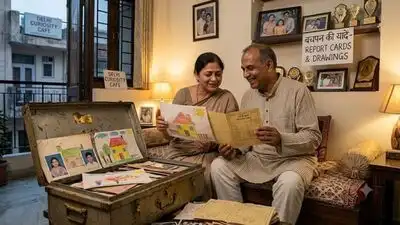
A faded report card, a colourful drawing made with uneven crayons or a tiny note written in a child’s handwriting may seem like ordinary pieces of paper. But for many parents, throwing them away can feel surprisingly difficult. Even when children grow into adults, parents may continue to keep folders filled with schoolwork, drawings and handwritten notes. Some remain tucked away in cupboards, while others are displayed on refrigerators or carefully stored in memory boxes. At first, this habit may look like simple nostalgia. But psychology suggests that these objects can carry a much deeper meaning. They can act as reminders of important experiences, relationships and stages of family life that cannot be recreated in exactly the same way.
A picture made by a six-year-old may remind a mother or father of the home they lived in at the time, the child’s personality, a school event or even a particular conversation. The drawing itself may not have much artistic value, but it can act as a doorway into an entire period of family life. The same can happen with a report card. Years later, it may bring back memories of a child’s first achievement, the excitement of coming home from school or the parent helping with homework. Another explanation comes from research on nostalgia . Psychologists Constantine Sedikides and Tim Wildschut have extensively studied nostalgia and its connection with memories, relationships and meaningful experiences. Their work suggests that nostalgia is often a positive emotional experience involving important people, places, objects and moments from the past. That can make an otherwise worthless object feel incredibly valuable. An old report card may no longer have any practical purpose once a child becomes an adult. But to a parent, it may represent a time when the child was still coming home with a schoolbag, asking for help with homework or proudly showing their latest achievement.
A tiny drawing made by a five-year-old can look strikingly different when the child is now an adult. The contrast can remind parents just how quickly childhood passed. This can become particularly emotional when children leave home, graduate, get married or begin families of their own. Still, keeping old schoolwork does not automatically mean someone is overly attached to the past. Some parents simply enjoy preserving family memories, while others may hope their children will appreciate the objects later. Psychology cannot determine someone’s personality simply from a box of old drawings. What it can help explain is why something as simple as a report card or a child’s drawing can carry a value that has nothing to do with money. Sometimes, parents are not really holding on to a piece of paper. They are holding on to a moment in time that the paper helps them remember.