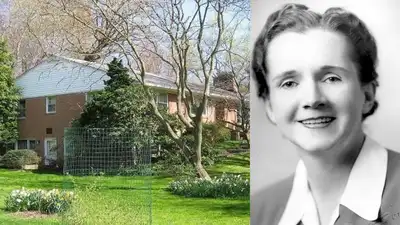
Image: Left/Exterior of the Rachel Carson House/NPS/Right/Carson in 1943/ National Digital Library of the United States Fish and Wildlife Service
In 1952, American biologist and writer Rachel Carson resigned from her government job and bought a cottage in Southport, Maine, where she began original research on tidal pool ecosystems. Six years later, in 1958, she began work on what would become her most famous book, Silent Spring, published in 1962. Born in 1907, Carson grew up on a farm in Springdale, Pennsylvania, where her parents encouraged her exploration of the natural world. She studied English at Pennsylvania College for Women before switching to biology in her junior year, graduating with honours in 1929, according to the National Park Service. In 1936, she joined the Bureau of Fisheries, later the Fish and Wildlife Service, writing scientific pamphlets for the public. By 1949, Carson had become Editor-in-Chief of all Department of publications. In 1951, she completed her second book, The Sea Around Us, which was serialised by The New Yorker and spent months on The New York Times bestseller list. The following year, in 1952, she resigned from her government post and bought a cottage in Southport, Maine, where she conducted original research on tidal pool ecosystems. This research fed into her third book, The Edge of the Sea, written in 1955, which completed her anthology on the natural history of the ocean. Published in 1962, Silent Spring provoked an immediate reaction, the chemical industry spent hundreds of thousands of dollars attempting to discredit Carson, while President Kennedy convened the Presidential Science Advisory Committee to examine her claims, which it ultimately verified. The book sold over 600,000 copies that year, and Carson’s work is widely credited as a catalyst for the creation of the Environmental Protection Agency in 1970. Carson died of cancer in her Silver Spring home on 14 April 1964.
The book exposed the dangers of indiscriminate pesticide use and helped spark the modern environmental movement. Here’s how Carson’s path from marine biologist to bestselling author led to one of the most influential books of the twentieth century. She went on to earn a Master of Science in zoology and genetics from Johns Hopkins University, then taught there and at the University of Maryland. Four years later, America marked its first Earth Day, and her former home now houses the Rachel Carson Landmark Alliance.