
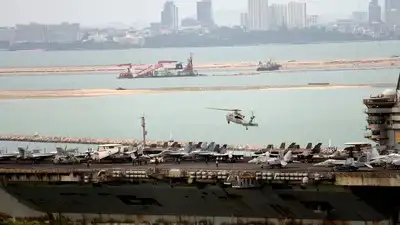
8 sailors in USS Abraham Lincoln strike group attempted suicide: Navy
Eight US Navy personnel assigned to the USS Abraham Lincoln carrier strike group attempted suicide during its lengthy deployment, including a period in which the group conducted combat operations against Iran, Acting Navy Secretary Hung Cao told Congress.
The carrier strike group included between 6,000 and 7,000 sailors deployed across roughly half a dozen ships. The number of attempts was roughly consistent with the rate recorded across the active-duty Navy in 2024, according to the data cited in the material. The Navy recorded 356 suicide attempts that year among an estimated 337,000 active-duty sailors. The carrier had around 5,000 crew members aboard during its deployment.
Because of the combat operations that prevented the carrier from making regular stops at friendly ports, other sailors who spoke with CNN described conditions that they said were different from their previous deployments, largely. Cao’s letter also confirmed incidents in which sailors went overboard or attempted to go overboard. CNN had previously reported that two sailors assigned to the Lincoln strike group, including one from the carrier and another from a different ship, had jumped overboard in recent months.
No service member died by suicide during the deployment, according to Cao’s letter. Eight suicide attempts across carrier strike group Cao said the eight suicide attempts involved personnel across the wider Abraham Lincoln strike group rather than only sailors serving aboard the carrier. “Since the beginning of Lincoln’s deployment, there have been a total of eight suicide attempts across the strike group,” Cao wrote to Gillibrand in the letter dated Tuesday. “Eight attempted suicides is incredibly high,” the official said, adding that recent carrier strike group deployments had recorded one or two attempts per year. Cao said the Lincoln strike group had multiple mental health and other support resources available to sailors throughout the deployment. The carrier had five chaplains and several mental health professionals to address the “spiritual and emotional needs of the crew”. The resources included five chaplains, one embedded integrated prevention counsellor, one psychologist, one clinical social worker, three behavioural health technicians and one expeditionary facility dog, according to Cao’s letter. He said a sailor assigned to the carrier’s airwing went overboard in early August but was “quickly recovered” and treated by the Lincoln’s medical department. Both were rescued, according to US officials. Other sailors were reportedly prevented from jumping overboard, according to reports cited from Navy Times and Stars and Stripes. The Navy had said it had not observed an increase in suicidal ideation or suicide attempts aboard the ship. A US official had also previously told CNN that the Navy did not believe there was a correlation between the length of the deployment and thoughts of self-harm. The official also said man-overboard incidents were not unique to the Lincoln strike group. The Navy did not respond to a request for comment about Cao’s letter ahead of publication, according to CNN. A crew member serving aboard the Lincoln previously told CNN that morale was very low and that they had repeatedly heard about suicidal ideation among fellow crew members. “Everyday we wake up and listen to our captain speak, we are desperately hoping and anxious for updates on our return,” the crew member said while the carrier was still awaiting orders to return to its home port in San Diego. The extended absence of such stops added to the strain of the deployment, according to the sailors cited in the report. However, he acknowledged temporary “localized piping failures” and problems with the carrier’s reverse osmosis desalination units. He also said that “main entree options” at meals had been reduced from two to one for a “short time”.
The carrier strike group, which has been deployed since November, is now returning to the United States after an extended period at sea. “This number includes the Lincoln crew and sailors from the carrier airwing, strike group and destroyer squadron staff, escorting destroyers and all embarked aviation squadrons. The USS Abraham Lincoln itself remained out of port for more than six months while conducting a high tempo of combat operations against Iran. One US military official, speaking to CNN, described eight attempts as unusually high compared with recent carrier strike group deployments. “The strain of combat ops is much higher than normal deployments. No port calls, constant alerts, etc. The disclosure came after family members of sailors raised concerns about deteriorating mental health and difficult conditions aboard the carrier during its prolonged deployment. “Additionally, one sailor attempted to go overboard in March and was stopped by his shipmates. That sailor was also provided immediate medical care and subsequently returned to homeport. “We have not observed an increase in suicidal ideations or attempts aboard the ship. We take every service member’s well-being seriously and have religious, medical and mental health professionals available to assess and address concerns as they arise. Concerns about the mental health of sailors had emerged alongside complaints about conditions aboard the carrier. The sailor also described recurring problems with basic amenities. Toilets and water fountains around the carrier frequently closed, while hot water was often unavailable. Port calls allow ships to take on fresh supplies and give sailors opportunities to rest and relax. Cao’s letter denied widespread concerns over broken plumbing and shortages of fresh food.
The disclosure of eight suicide attempts comes after the Navy previously denied that the Abraham Lincoln was experiencing a mental health crisis. The Navy has previously acknowledged supply challenges aboard the USS Abraham Lincoln but rejected broader claims about deteriorating conditions. Cao disclosed the number in a letter to Senator Kirsten Gillibrand of New York on Tuesday, responding to questions from the Democrat about the morale and mental health of sailors serving aboard the carrier and other ships in the strike group.
The USS Abraham Lincoln’s deployment stretched across roughly nine months, with the carrier leaving the Middle East in August and expected to return to San Diego in the coming weeks. In August, the USS George Washington was sent to replace the Abraham Lincoln following its nine-month deployment. The Lincoln’s prolonged deployment included combat operations against Iran and an extended period without regular port calls, while the Navy maintained that it had not observed an increase in suicidal ideation or attempts aboard the ship. You use AI every day. Now get your AI Quotient. Take the AIQ test.