
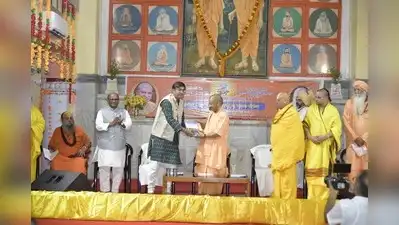
Gorakhpur: On Thursday, Chief Minister Yogi Adityanath emphasized the importance of safeguarding India’s ancient knowledge tradition, which he claims has been threatened by foreign invasions and colonial policies. He urged the need to identify and preserve the country’s intellectual heritage. Adityanath highlighted the role of documentary evidence and modern technology in presenting this heritage to a global audience.
“Attacks on temples and centres of learning at different points in history were aimed not only at plundering wealth but also at weakening India’s civilisational and intellectual foundations,” he said while addressing a conference on “Indian Knowledge Tradition in the Contemporary Context” at Mahant Digvijaynath Smriti Bhawan in Gorakhnath Temple complex. Yogi said India’s knowledge systems had made pioneering contributions in fields ranging from language, grammar and economics to astronomy, science, medicine and technology. Ancient centres of learning, he said, produced scholars of global stature, and preserving this heritage would enable India to make a greater contribution to global welfare. Referring to sages, scholars and traditional institutions of learning, he said Indian civilisation had always encouraged reflection on the past, present and future, while viewing knowledge as a path to liberation rather than merely a means of material advancement. The chief minister said India was once regarded as a “Vishwaguru” because of its rich intellectual traditions. More than one lakh ancient manuscripts are being preserved and digitised at Sampurnanand Sanskrit University in Varanasi, according to the chief minister.
He cited ancient universities such as Taxila and Nalanda, and noted that centres including Kashi, Ujjain and Kanchi played a pivotal role in advancing knowledge. He also described Kumbh as a platform where saints and scholars exchanged ideas and shared learning. Highlighting recent initiatives, Yogi credited Prime Minister Narendra Modi with promoting yoga globally and strengthening traditional systems of medicine through Ayush Ministry. Similar heritage material has also been identified in temples, monasteries and private collections across Uttar Pradesh.
Former Uttar Pradesh Higher Education Service Commission chairperson Prof Ishwar Sharan Vishwakarma said National Education Policy (NEP) 2020 had created new opportunities for integrating Indian knowledge systems into higher education.