
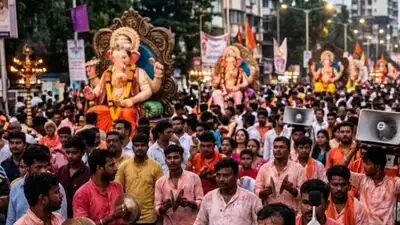
Mumbai’s final Ganpati visarjan highlighted a decrease in truck-mounted DJs and loudspeakers during processions
MUMBAI: Mumbai’s final Ganpati visarjan on Friday saw a noticeable shift away from truck-mounted DJs and loudspeakers in processions, but high-decibel noise continued at several locations, with a peak reading of 107.8 decibels (dB) recorded at Bandra West, according to Awaaz Foundation. The reading was recorded at 10.03pm, where a banjo being amplified through loudspeakers registered 91-107.8 dB. At Worli, dhol-tasha without loudspeakers registered 94-107 dB at 10.28pm.
At Girgaon Chowpatty, a political party booth using loudspeakers recorded 92-103 dB at 11.15pm . Awaaz subsequently recorded 87-94 dB at 12.18am at another political booth using loudspeakers, while loudspeaker use continued at 12.30am, when the reading was 82-90 dB. On September 21, the Bombay high court took suo motu cognisance of sound pollution during the Ganesh festival and questioned the rationale for permitting loud music during processions up to midnight. Mumbai’s 2026 notification permitted sarvajanik Ganesh mandals to use loudspeakers and amplifiers until midnight on September 15, 18, 19 and 25 , subject to the Noise Pollution (Regulation and Control) Rules, 2000, court directions and other conditions. During 6am-10pm , the limit is 55 dB(A) Leq in residential areas and 50 dB(A) Leq in silence zones. During 10pm-6am , these fall to 45 dB(A) and 40 dB(A) respectively. Commercial areas have limits of 65/55 dB(A) and industrial areas 75/70 dB(A), for day/night respectively. The 2026 notification itself made the extension subject to prescribed noise limits. Awaaz recorded 84.9-87 dB at Opera House at 12.06am on September 26, 2026 , during a procession without loudspeakers. In 2024, Awaaz’s highest visarjan reading was 115 dB at Opera House around 12.22am . Its reported peak for 2023 was 114.7 dB. That makes the 2026 Opera House reading substantially lower than the 2024 peak at almost the same location and time. Awaaz’s reported historical peaks were 120.2 dB in 2022, 114.7 dB in 2023 and 115 dB in 2024 . Maharashtra Pollution Control Board’s official 2024 Ganesh-festival monitoring, meanwhile, uses Leq dB(A) methodology and compares equivalent continuous noise levels across locations and years. Its report found that maximum levels during peak festivities in 2024 were lower than in 2022 and broadly similar to 2023.
A 100-plus dB reading taken close to a drum or loudspeaker therefore cannot, by itself, establish a statutory violation. Because the supplied Awaaz data does not establish identical measurement conditions or methodology across all years, but the figures should not be presented as a formal year-on-year regulatory comparison. Because of heavy rain, according to the foundation, no readings were taken in 2025. The 2026 measurements therefore point to two simultaneous developments: less dependence on amplified procession sound, but continued episodes of very high noise at individual locations .
You Can Also Check: Gold Rate in Mumbai | Silver Rate in Mumbai | Bank Holidays in Mumbai | Public Holidays in Mumbai | Mumbai AQI | Weather in Mumbai | Petrol Price in Mumbai | Diesel Price in Mumbai | CNG Price in Mumbai | LPG Price in Mumbai Stay updated with the latest Mumbai news.
The Noise Rules prescribe ambient noise limits according to the area’s classification. The findings come amid renewed judicial scrutiny of festival noise. She alleged that political parties across the spectrum continued to use loudspeakers at high volumes and beyond midnight. Loudspeakers remain prohibited in designated silence zones. Crucially, these are time-weighted ambient Leq standards , not a ceiling on every instantaneous sound-meter reading. The applicable zone, measurement point, duration and prescribed methodology have to be considered. The state’s midnight exemption similarly concerns timing , not a blanket relaxation of the applicable noise standards. One comparison is particularly striking. For residents living along immersion routes, the issue is ultimately not just whether DJs are present. It is whether permitted timings, area-specific ambient standards, silence-zone restrictions and measurement protocols are followed consistently — including when the clock approaches midnight. Download the TOI App.
Awaaz Foundation founder Sumaira Abdulali, in a letter to chief minister Devendra Fadnavis on Saturday, said most Ganesh mandals had given up DJs and loudspeakers mounted on trucks during processions.